Why do we have tourism signage
The white on brown tourism signs, introduced in the 1980’s, are primarily to guide visitors to tourist destinations, nevertheless they also help to generate more impromptu visits.
The provision of tourist signing is also seen as a vitally important aid to the economy of Torbay, especially for businesses which rely heavily on visitors.
Policy
It is important that road safety, traffic management and the environment are given due consideration when dealing with applications for tourism signs.
In developing its policy the Council have considered two main issues:
- Assessment of the application based on quality considerations, and
- How and where signing might be provided.
Tourism signs are traffic signs and as such their purpose is to safely guide those wishing to visit a tourist destination along the most appropriate route, having regard for the environment, for the latter stages of their journey, or to indicate facilities that a tourist would not reasonably expect to find in that location.
Tourist signs should not however be used as a means of advertising or promoting an attraction and highway authorities are required to set appropriate guidelines and policies to ensure that there is no proliferation of numbers of signs leading to excessive clutter on the highway network.
It is envisaged that there may be times when the demand for signs is greater than the number that can be safely provided. In these circumstances regular reviews will take place to give all potential sign applicants the opportunity for signing. Whilst every effort will be made to minimise the number of locations where this may occur it is possible that some signing to destinations will be removed after three years.
What is a tourist destination
A tourist destination is:
A permanently established destination or facility which attracts or is used by visitors to an area, and open to the public without prior booking during its normal opening hours.
As tourists would normally expect to find a signed destination open, a minimum period has been applied to ‘normal’ opening hours of at least 4 hours a day, 180 days a year.
Will my estabilishment qualify for tourism signing
In order to make assessments meaningful, the broad term tourist destination has been divided into categories, these are:
Attractions
Places of interest open to the public offering recreation, education or historical interest.
Examples are: Theme Parks, Historic Houses, Museums, Zoos, Leisure Complexes, Natural attractions (nature reserves, beaches) and areas of Special Interest.
Facilities – Urban and Rural
Establishments that provide services within an area. Examples are: Accommodation, Pubs, Restaurants, Cafes, Shops, Cinemas/Theatres, Local Sport and Leisure Facilities.
Touring Camping and Caravan Parks
Camping and/or caravan parks which have pitches available for the use of all touring campers and caravanners. There should be no limitation that is based on membership only or is dependent on pre-booking.
How do I apply for signing
If having read the previous section you believe your establishment may be eligible for signing an application can be made online via the Torbay Council website. Upon submission of the application a non-refundable assessment fee of £100.55 is required.
It should be noted that eligibility does not mean entitlement.
Assessments
Assessments will be considered against the following:
- Quality – Minimum standards suggested by the Tourist Boards. Quality Guidelines are given in Annex 1.
- Publicity – Evidence must be provided that the establishment is publicised in local or national publications or media.
- Advertising signs – No advertising sign will be permitted near a proposed tourism sign.
- Car Parking Facilities – Adequate parking must be available.
- Planning Regulations – The destination must be suitably authorised.
When will I know the result of my application
You will be informed in writing of the result of the initial assessment at the earliest opportunity.
If your application initially qualifies, you will be notified and sent guideline costs for providing signs. A financial agreement will also be sent to you for your signature and return. This will formally give your agreement to meet the costs of detailed sign design and provision, and
erection of signs.
Should your application not qualify an explanation will be given as to why your application is being refused.
What happens next
Where a financial agreement has been signed and returned, then a detailed signing scheme will be prepared in line with road safety and traffic management requirements and taking into account environmental considerations.
It should be noted that levels of signing will vary between rural and urban areas.
For information the following are some of the main requirements which will be followed by the designer of your signing scheme.
General
- Establishments with access directly onto the major road network will only be considered for signing if justified on road safety grounds.
- Generally no more than four tourist destinations will be signed from any one junction for road safety reasons. Normally the destinations with the greater number of visitors will be considered for signing. If this does not indicate any particular ranking then they may be chosen on the basis of their proximity to the junction.
- Normally generic legends will be used where there are two or more facilities of the same type whether in one area, or along a particular route.
- Names of touring Camping and Caravan Parks may be included on the signs if there is possibility of confusion. For example, where there may be two or more parks close together, or signed from the same junctions in different directions.
- Continuity of signing will be required from the initial sign to the tourist destination being signed. In order to reduce environmental impact where a scheme involves signing along more than two junctions, then signs of the ‘For x, follow y’ type will be used, utilising where possible existing signing legends rather than providing additional continuity signing.
- Schemes will be subject to review every third year, unless signs are reviewed under a particular improvement scheme.
- Signing to some attractions or facilities are not considered within Town Centre or Sea Front areas. This would be deemed to include establishments on or accessed immediately from the main highway network within destinations signed as ‘Town Centre’, ‘Sea Front’ or ‘Harbour’ on existing directional signing.
Attractions
- Signing for attractions will normally only be agreed from the nearest major road junction.
- In urban areas the priority will be to direct tourists to public car parks. Vehicular signing for urban facilities will be limited and normally will only be from the signed routes to the town centre car parks. Signing to facilities (and back) from car parks and principal public transport points will take the form of pedestrian signing from those points.
Touring Camping and Caravan Parks
- These must be licensed under the Caravan Sites control of Development Act 1960 and/or the Public Health Act 1936, and there must be a minimum of 20 pitches available for casual overnight use.
- It should be noted that during the detailed design stage it may become apparent that signing of a destination cannot be accommodated even though problems were not foreseen at the initial assessment stage. It is expected that this will only occur in exceptional circumstances as a result of unforeseen road safety and/or traffic management reasons. If this situation arises, the Council will not make any charge to the applicant for the detailed design that has been undertaken.
Shall I have a symbol on the signs
Including a symbol on a sign can be beneficial in that it can indicate clearly the type of establishment. Only one symbol may be included for any one destination. If you have a preference for a symbol, it must be one of the approved symbols illustrated in the Traffic Signs Regulations and General Directions 2016 or subsequent update. Examples of symbols approved for use by the Department for Transport are detailed in the appendix of this policy.
What will it cost
It is expected that the full cost will be met by those who will benefit from the provision of the signs. Consequently, the provision of tourism signing should normally result in no cost to Torbay Council.
Applicants will be liable for costs incurred by the Council as follows:
Stage 1 – Initial Assessment
Initial assessment of the application against both quality and traffic considerations. Provisions of programme of probable implementation and likely costs.
Charge: £100.55
Stage 2 – Detailed Design
Detailed design of the signing scheme, including an estimation of costs for the provision and erection of signs, and production of necessary documents.
Charge: At cost.
Stage 3 – Provision of Signs
Supply and installation of signs in accordance with current specifications and standards.
Charge: At cost.
Stage 4 – Maintenance
A cost to cover the future maintenance of the signs by the Council.
This will include cleaning, replacement/repair of fixings, replacement of signs following accident damage where a claim can be made against a known third party.
Charge: 10% of total Stage 3 costs.
The following points should be noted:
- Where your application qualifies to proceed following the Stage 1 assessment, you must then enter a signed agreement with the Council accepting to meet the costs involved in Stages 2, 3 and 4 before further work will be carried out.
- Should you decide not to proceed after receiving the detailed design you will nevertheless be liable for the Stage 2 costs incurred by the Council in preparing the design.
- The supply and installation of signs (Stage 3) will not normally be undertaken until the associated costs have been received by the Council.
- The maintenance cost for Stage 4 does NOT include replacement of signs caused by theft, or following accident damage caused by an unknown third party or by adverse weather conditions, or when the signs reach the end of their useful life.
In these circumstances the applicant will be liable for all replacement costs and are consequently advised to take out insurance to cover these eventualities.
- When more than one destination is included on a sign(s) the costs will be shared by the applicants. Should an applicant choose not to proceed the cost will be re-apportioned between the remaining applicant(s).
- Where an application is made on behalf of several establishments it will be necessary to identify a single person or body who will be responsible for signing the agreement.
- The Council reserves the right to recover the cost of removal of tourism signs including any replacement of existing signs where the tourism signs formed an integral part of the sign assembly, either, where the destination has ceased to meet the standards under which the signs were provided or if it is found that questions were incorrectly answered on the application form.
Although the signs are paid for by the applicant they will remain the property of the Council who retain the right to remove them.
Quality guidelines used for certain individual urban and rural facilities
General
- The attraction must show that a significant number (at least 40%) of its visits are from outside the area (more than 10 miles).
- The attraction must demonstrate a significant value to the local tourist market. The applicant may be required to carry out a survey at their own expense to justify this requirement if deemed to be in doubt by the highway authority.
Accommodation
- The accommodation will only be considered when it is located within a by-passed community and more than one opportunity for accommodation is available.
- The relevant symbol with descriptive wording such as ‘Hotel’ or ‘Inn’ will only be permitted, unless the establishment has significant historic or local interest.
- Accommodation will not be signed in Sea Front or Town Centre areas.
- Only inspected accommodation will be considered for tourism signing (normally ETB, AA, RAC or Visit Britain).
The accommodation must normally be available to non pre-booked tourists.
Public Houses (Including Free Houses, Inns etc)
- Public Houses will only be considered where they are located within a by-passed community.
- The relevant symbol with description wording such as ‘Inn’ will only normally be permitted unless the establishment has significant local or historic value.
- Public Houses will not be signed in any Sea Front or Town Centre areas.
- Meals, not just bar snacks, should be served at lunchtime and during the evening.
- The establishment should have a childrens certificate, or there should be the ability to accommodate children indoors.
Restaurants (including Cafes)
- Restaurants will only be considered where they are located within a by-passed community.
- The relevant symbol with descriptive wording such as ‘restaurant’ or ‘café’ will only normally be permitted unless the establishment has significant local or historic value.
- Restaurants will not be signed in any Sea Front or Town Centre areas.
- Customers should expect to be able to obtain a meal without pre booking.
- There should be a full a la carte menu and waiter/waitress service.
- Take-away outlets without adjoining restaurant/café facilities will not be considered for signing.
Retail Outlets
- The outlet should depend predominantly on tourists for its revenue.
- No individual outlet will be signed within a shopping centre, Town Centre or Sea Front area.
- Outlets will only be considered for signing when they are in a by-passed community and/or provide additional interest or education for the tourist rather than primarily retail.
Touring Camping and Caravan Parks
- Must be licensed under the Caravan Sites Control of Development Act 1960 and/or the Public Health Act 1936.
- There must be a minimum of 20 pitches available for casual overnight use.
Recreational Facilities
Should not have any limitations on use that is based on membership only or is dependent on prebooking.
APPENDIX – 1
Examples of the commonly used tourism symbols approved for use by the Department for Transport
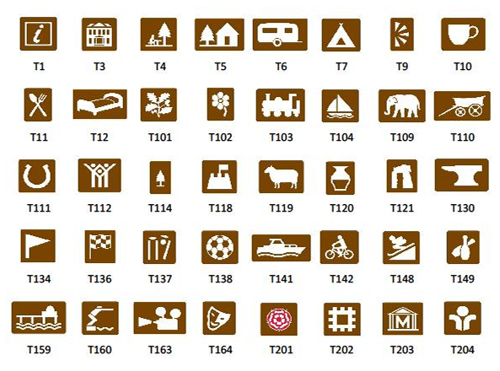
Further reading on the names, descriptions and correct use for each symbol can be found within the document ‘The Traffic Signs regulations & General Directions 2016’ or subsequent revision (Schedule
12, Part 16 on Pages 311 to 322) which can be found at www.legislation.gov.uk search ‘Traffic signs’. Successful applicants will be guided on the suitability and correct use of the symbols.