Borough of Torbay: Various Streets, Torquay, Control of waiting, loading and unloading) Amendment Order Number 5 2026
Statement of Reasons
The proposals in this Order are to support a major highway improvement and maintenance scheme along Torbay Road, delivering significant benefits for pedestrians, public transport users, residents, businesses and visitors.
The scheme will include the installation of a new zebra crossing outside the Princess Theatre, making it safer and easier for people to move between the seafront, attractions and surrounding areas. The proposals in this Order will support the scheme by amending current parking restrictions to provide space for the crossing point to be implemented.
Public transport users will also benefit from the introduction of new bus stops at Abbey Crescent, supporting easier access to bus services and encouraging more sustainable travel choices.
The scheme will see a reduction in the number of on-street pay and display parking places along Torbay Road, the proposals for which are detailed in separate proposals (“Borough of Torbay (Street Parking Places {Pay and Display}) Amendment Order Number 1 2026”).
Documents giving more details of the particulars of all of the proposed changes are shown on plans on deposit.
Borough of Torbay: Various Streets, Torquay, Control of Waiting, Loading and Unloading, Amendment Order Number 5 2026
Torbay Council proposes to make the above Order under the provisions of the Road Traffic Regulation Act 1984, the effect of which would be to amend the existing and to introduce new measures in the following specified lengths of road in Torquay, as follows:-
Schedule 1: Revocations
No Waiting At Any Time
Torbay Road
(i) the south side from a point 248 metres north-east of its junction with The Kings Drive in an easterly direction to a point on the south carriageway 215.2 metres east of its junction with Shedden Hill Road.
(ii) the south side of the south carriageway from a point 258.3 metres west of the junction with Vaughan Road westwards for a distance of 14 metres.
(iii) the north side of the north carriageway from a point 191 metres east of the junction with Shedden Hill Road in an easterly direction for a distance of 28 metres.
No Loading At Any Time
Torbay Road
(i) the south side from its junction with Shedden Hill Road in an easterly direction leading onto the south carriageway for a distance of 215.2 metres.
(ii) the south side of the south carriageway from a point 258.3 metres west of the junction with Vaughan Road westwards for a distance of 14 metres.
Disabled Badge Holders Only, Max Stay 4 hours
Torbay Road
(i) the south side of the south carriageway from a point 219.2 metres east of its junction with Shedden Hill Road south-eastwards for a distance of 13.2 metres.
(ii) the north-east side of the northern carriageway from a point 218.9 metres east of the junction with Shedden Hill Road south-eastwards for a distance of 13.2 metres.
(iii) the south side of the south carriageway from a point 272.3 metres west of its junction with Vaughan Road in a westerly direction for a distance of 13.2 metres.
Loading Only, 8am to 6pm
Torbay Road
The south side of the south carriageway from a point 243.3 metres west of its junction with Vaughan Road in a westerly direction for a distance of 15 metres.
No Waiting Except Taxis, 6pm to 8am
Torbay Road
The south side of the south carriageway from a point 243.3 metres west of its junction with Vaughan Road in a westerly direction for a distance of 15 metres.
Buses Only, Limited Waiting 20 Minutes, No Return Within 40 Minutes
Torbay Road
The south side of the south carriageway from a point 212.3 metres west of its junction with Vaughan Road in a westerly direction for a distance of 31 metres.
Motor Cycle Only Parking
Torbay Road
The south side of the southern carriageway from a point 215.2 metres east of the junction with Shedden Hill Road south-eastwards for a distance of 4 metres.
Schedule 2: No Waiting At Any Time
Torbay Road
(i) the south side from a point 248 metres north-east of its junction with The Kings Drive in an easterly direction to a point on the south carriageway 231.2 metres east of its junction with Shedden Hill Road.
(ii) the south side of the south carriageway from a point 235.3 metres west of its junction with Vaughan Road in a westerly direction for a distance of 26.5 metres.
(iii) the north side of the north carriageway from a point 191 metres east of the junction with Shedden Hill Road in an easterly direction for a distance of 47 metres.
Schedule 3: No Loading At Any Time
Torbay Road
(i) the south side from its junction with Shedden Hill Road in an easterly direction leading onto the south carriageway for a distance of 212.2 metres.
(ii) the south side of the south carriageway from a point 235.3 metres west of its junction with Vaughan Road in a westerly direction for a distance of 26.5 metres.
Schedule 4: Loading Only, 8am to 6pm
Torbay Road
The south side of the south carriageway from a point 261.8 metres west of its junction with Vaughan Road in a westerly direction for a distance of 16 metres.
Schedule 5: No Waiting Except Taxis, 6pm to 8am
Torbay Road
The south side of the south carriageway from a point 261.8 metres west of its junction with Vaughan Road in a westerly direction for a distance of 16 metres.
Schedule 6: Disabled Badge Holders Only, Max Stay 4 hours
Torbay Road
(i) the south side of the south carriageway from a point 235.6 metres east of its junction with Shedden Hill Road in a south-easterly direction for a distance of 13.2 metres.
(ii) the north side of the north carriageway from a point 238 metres east of the junction with Shedden Hill Road in a south-easterly direction for a distance of 14 metres.
(iii) the south side of the south carriageway from a point 277.8 metres west of its junction with Vaughan Road in a westerly direction for a distance of 13.4 metres.
Schedule 7: Buses Only, Limited Waiting 20 Minutes, No Return Within 40 Minutes
Torbay Road
The south side of the south carriageway from a point 212.3 metres west of its junction with Vaughan Road in a westerly direction for a distance of 23 metres.
Schedule 8: Motor Cycle Only Parking
Torbay Road
The south side of the south carriageway from a point 231.2 metres east of its junction with Shedden Hill Road in a south-easterly direction for a distance of 4.4 metres.
Documents giving more detailed particulars of the Order may be inspected between 9:00am and 5:00pm each working day on the self-service computers at the Torbay Council Connections Office, Paignton Library and Information Centre, Great Western Road, Paignton, TQ3 3HZ. The documentation may also be viewed online at the following web address:
www.torbay.gov.uk/parking/tro/torquay-tros/
All objections and representations relating to the Order must be submitted in writing to the address given below, or via email at tro.consultation@torbay.gov.uk to arrive no later than Wednesday 7th October 2026 and all objections must state the grounds on which they are made.
Date: Thursday 17 September 2026
Parking Services
Torbay Council
Town Hall, Castle Circus
Torquay TQ1 3DR
Dated 2026
Borough of Torbay
(Various Streets, Torquay)
(Control of waiting, loading and unloading)
Amendment Order Number 5 2026
Anne-Marie Bond
Chief Executive
Torbay Council
Town Hall
Torquay
TQ1 3DR
Borough of Torbay
(Various Streets, Torquay) (Control of waiting, loading and unloading)
Amendment Order Number 5 2026
The Council of the Borough of Torbay in exercise of its powers under Sections 1(1), 2(1) and (2)4 and Part IV of Schedule 9 of the Road Traffic Regulation Act 1984 (hereinafter referred to as “The Act”) and of all other enabling powers and after consultation with the Chief Officer of Police in accordance with Part III of Schedule 9 of the Act hereby makes the following Order:-
1. This Order shall come into force on the day of and may be cited as the “Borough of Torbay (Various Streets, Torquay) (Control of Waiting, Loading and Unloading) Amendment Order No.5 2026”.
2. (1) In this Order the following expressions have the meanings hereby respectively assigned to them:-
“authorised loading bay” means any authorised loading bay referred to in Article 5 which is either -
(a) bounded on one side or more than one side by the edge of the carriageway of a length of road and on the other side or sides by a traffic sign indicating the limits of the area of carriageway within which a vehicle may be parked; or
(b) bounded on all sides by a traffic sign indicating the limits of the area of carriageway or the area of footway or the area of both footway and carriageway, as the case may be, within which a vehicle may be parked,
and the boundaries referred to in paragraphs (a) and (b) above shall be taken to be the limits of an authorised loading bay for the purposes of Article 9 of this Order; “bus” and “buses” have the same meaning as given in Schedule 1 of the Traffic Signs Regulations and General Directions 2016;
“bus” has the same meaning as in Schedule 1 of the Traffic Signs Regulations and General Directions 2016;
"civil enforcement officer" means a person in uniform authorised by or on behalf of the Council to enforce the provisions of this Order;
"disabled person's badge" has the same meaning as in Regulation 3(1) of the Local Authorities’ Traffic Orders (Exemption for Disabled Persons) (England) Regulations 2000 and “relevant position” has the same meaning as in Regulation 4 of those Regulations;
"driver" in relation to a vehicle waiting in a length of road specified in a Schedule to this Order means the person driving the vehicle at the time it was left in that length of road;
“motorcycle” has the same meaning as in Section 136 of the Road Traffic Act of 1984;
"parking disc" means a disc which has been issued by a local authority and has not ceased to be valid, is 125mm square and coloured blue and is capable of showing the quarter hour period during which a period of waiting has begun;
“parking place” means any area of a length of road referred to in Article 4 or Article 5 provided for the leaving of a vehicle or vehicles and “parking space” means any individual area within a parking place provided for the leaving of one vehicle only, and which is either -
(a) bounded on one side or more than one side by the edge of the carriageway of that length of road and on the other side or sides by a traffic sign indicating the limits of the area of carriageway within which a vehicle may be parked; or
(b) bounded on all sides by a traffic sign indicating the limits of the area of carriageway or the area of footway or the area of both footway and carriageway, as the case may be, within which a vehicle may be parked,
and the boundaries referred to in paragraphs (a) and (b) above shall be taken to be the limits of a parking place or the limits of a parking space, as the case may be, for the purposes of Article 9;
“penalty charge” means the charge set under the provisions of the Traffic Management Act 2004, with the approval of the Secretary of State for Transport, which is to be paid to the Council following the issue of a penalty charge notice;
“penalty charge notice” means a notice issued or served by a parking attendant pursuant to the provisions of the Traffic Management Act 2004;
"postal packet" has the same meaning as in the Postal Services Act 2000;
“road” means the carriageway and any footway, pavement, verge, or grass verge comprising a road;
"taxi" has the same meaning as in Schedule 1 of the Traffic Signs Regulations and General Directions 2016;
"taxi rank" has the same meaning as in Schedule 1 of the Traffic Signs Regulations and General Directions 2016, comprising an area of carriageway within and indicated by a traffic sign complying with either diagram 1028.2 or 1028.5 in Schedule 7 of those Regulations;
“traffic sign” means a traffic sign of the size, colour or type prescribed or authorised under section 64 of the Road Traffic Regulation Act 1984, including any line or marking on a road;
“vehicle” includes any part of a vehicle.
(2) Except where otherwise stated any reference in this Order to a numbered Article or Schedule is a reference to the Article or Schedule bearing that number in this Order.
3. Without prejudice to the validity of anything done before or to any liability incurred before the coming into force of this Order, the Orders specified in Schedule 1 are hereby revoked.
4. Save as provided in Articles 6 and 7 no person shall, except upon the direction or with the permission of a police constable in uniform, or a civil enforcement officer, cause or permit any vehicle to -
(a) wait at any time in any length of road specified in Schedule 2;
(b) be loaded or unloaded at any time in any length of road specified in Schedule 3;
5. Save as provided in Article 8 no person shall, except upon the direction or with the permission of a police constable in uniform, a traffic warden, or a civil enforcement officer, cause or permit any vehicle –
(a) to wait other than for the purpose of enabling goods to be loaded on or unloaded from that vehicle between the hours of 8am and 6pm on any day of the week, in any authorised loading bay specified in Schedule 4;
(b) other than a taxi waiting, to stop in a taxi stand between the hours of 6pm and 8am in any length of road specified in Schedule 5;
(c) other than a vehicle displaying in the relevant position a disabled person’s badge and a parking disc (on which the driver or other person in charge of the vehicle has marked the time at which the period of waiting began), to wait for a longer period than 4 hours, in any length of road specified in Schedule 6;
(d) other than a bus only, to wait at any time in any length of road specified in Schedule 7 –
(i) for a longer period than 20 minutes;
(ii) if a period of less than two hours has elapsed since the termination of the last period of waiting (if any) by that vehicle in that length of road;
(e) other than a motorcycle only, to wait at any time in any length of road specified in Schedule 8;
6. Nothing in Article 4 shall render it unlawful to cause or permit any vehicle to wait in any of the lengths of roads referred to in those Articles for a period of not more than 20 minutes in the same place to enable goods to be loaded on or unloaded from the vehicle, provided that such loading or unloading is not prohibited by virtue of Article 4(b).
7. (1) Nothing in Article 4 shall render it unlawful to cause or permit any vehicle to wait in any of the lengths of roads referred to in that Article for so long as may be necessary to enable-
(a) a person to board or alight from the vehicle;
(b) the vehicle if it cannot conveniently be used for such purpose in any other road to be used in connection with any of the following operations namely-
(i) building, industrial or demolition operations;
(ii) the removal of any obstruction to traffic;
(iii) the maintenance, improvement or reconstruction of the said lengths of roads; or
(iv) the laying, erection, alteration or repair in or in land adjacent to the said lengths of roads of any sewer or of any main, pipe or apparatus for the supply of gas, water or electricity or of any electronic communications network within the meaning of the Communications Act 2003;
(c) the vehicle, if it cannot conveniently be used for such purposes in any other road, to be used in the service of a local authority or a water authority in pursuance of statutory powers or duties;
(d) the vehicle to be used for the purpose of delivering or collecting a postal packet or packets;
(e) the vehicle to be used for fire, ambulance or police purposes;
(f) the vehicle to be used for the purpose of collecting or delivering cash or valuable securities to banks, building society or post offices/ shops.
(g) in any case where the person in control of the vehicle –
(i) is required by law to stop;
(ii) is obliged to stop so as to prevent any accident; or
(iii) is prevented from proceeding by circumstances beyond their control.
(h) any vehicle belonging to the Post Office and other companies engaged for the purpose of collecting or delivering postal packets, cash or valuable securities to banks, building societies, post offices or post boxes and business premises.
(2) Nothing in Article 4 shall render it unlawful to cause or permit a vehicle which displays in the relevant position a disabled person’s badge and a parking disc (on which the driver or other person in charge of the vehicle has marked the time at which the period of waiting began) to wait in any length of road referred to in the said Articles for a period not exceeding three hours (not being a period separated by an interval of less than one hour from a previous period of waiting by the same vehicle in the same length of road on the same day) provided that such loading or unloading is not prohibited by virtue of Article 4(b).
8. Nothing in Article 5 shall render it unlawful for a person to cause or permit a vehicle to wait in an authorised length of loading bay –
(a) if the vehicle is being used for the removal of any obstruction to traffic; or
(b) if the vehicle is being used in the service of a local authority or a water authority in exercise of statutory powers or duties and whilst being so used in such service it is necessary for the vehicle to wait in that length of road, bus stop area, authorised loading bay or taxi rank or stand; or
(c) if the vehicle is being used for police, fire or ambulance purposes; or
(d) in any case where the person in control of the vehicle -
(i) is required by law to stop;
(ii) is obliged to stop so as to prevent any accident; or
(ii) is prevented from proceeding by circumstances beyond their control.
(e) any vehicle being used by dignitaries in pursuance of ceremonial duties on behalf of the local authority.
(f) any vehicle being a taxi to wait upon an authorised taxi rank or stand;-
(i) provided the driver is in the taxi and available for immediate hire when their taxi is first or second on an authorised taxi rank or stand; or
(ii) the driver is available when any other taxi immediately in front of their vehicle is driven off, or moved forward, so as to fill the space previously occupied by the taxi in front.
9. The driver of a vehicle waiting in an authorised parking place during the prescribed hours shall cause it so to stand:
(a) so that every part of the vehicle is wholly within the limits of the authorised bay;
(b) so that no part of the vehicle obstructs any vehicular or pedestrian means of ingress to or egress from any premises adjacent to the side of the road on which the vehicle is waiting;
(c) so that the longitudinal axis of the vehicle is parallel to the edge of the carriageway nearest to the vehicle and the distance between the said edge and the nearest wheel of the vehicle is not more than 30 centimetres.
10. If a vehicle is left or parked without complying with the provisions of this Order, then a contravention shall be deemed to have occurred and a penalty charge shall be payable. A penalty charge notice showing the information required by the Traffic Management Act 2004 may then be issued by a civil enforcement officer in accordance with the requirements of that Act.
11. When a notice has been attached to a vehicle in accordance with the provisions of Article 10 no person not being the driver of the vehicle or a person duly authorised by the Council shall remove the notice from the vehicle.
12. (1) The penalty charge shall be paid to the Council in accordance with the instructions indicated on the penalty charge notice, either –
(a) by cheque or postal order, which shall be delivered or sent by post to the address indicated in the penalty charge notice; or
(b) by any other accepted means which is agreed by the Council or authorised agent and the person or persons paying the penalty charge.
(2) The penalty charge must be paid to the Council before the end of twenty-eight days beginning with the date of the penalty charge notice.
(3) If the penalty charge is paid to the Council before the end of a period of fourteen days beginning with the date of the penalty charge notice, the amount of the penalty charge shall be reduced in accordance with the provisions of the Traffic Management Act 2004.
(4) For the purposes of this Article the penalty charge shall be taken to be paid when it is received at the office at the address indicated on the penalty charge notice and if the end of the period of twenty-eight days specified in paragraph (2) of this Article or the end of the period of fourteen days specified in paragraph (3) of this Article falls upon a day on which the said office is closed, the period within which payment of the penalty charge shall be made shall be extended until the time at which the said office closes on the next full day on which that office is open.
Suspension of Parking Places.
13. (1) Any person duly authorised by the Council may suspend the use of a parking place or any part thereof whenever he/she considers such suspension reasonably necessary:-
(a) for the purpose of facilitating the movement of traffic or promoting its safety;
(b) for the purpose of any building operation, demolition or excavation in or adjacent to the parking place or the maintenance, improvement or reconstruction of the parking place or the laying, erection, alteration, removal or repair in or adjacent to the parking place of any sewer or of any main, pipe or apparatus for the supply of gas, water or electricity or of any telegraphic line, traffic sign or parking meter;
(c) for the convenience of occupiers of premises adjacent to the parking place on any occasion of the removal of furniture from the premises to another or the delivery of furniture to the adjacent premises from another;
(d) on any occasion on which it is likely to by reason of some special attraction or sporting event that any street will be thronged or obstructed; or
(e) for the convenience of occupiers of the premises adjacent to the parking place at times of weddings or funerals, or on other special or commemorative occasions.
(2) A Police Constable in uniform may suspend for not longer than twenty-four hours the use of a parking place or any part thereof whenever he/she considers such suspension reasonably necessary for the purpose of facilitating the movement of traffic or promoting its safety.
(3) At the discretion of the Chief Officer of Police a parking place or any part thereof shall be suspended whenever he/she considers such suspension reasonably necessary to enable the police to discharge their duties.
(4) Any person suspending the use of a parking place or any part thereof in accordance with the provisions of paragraphs (1) or (2) above shall thereupon place or cause to be placed in or adjacent to that part or those parts a traffic sign or signs indicating that waiting is prohibited.
(5) No person shall cause or permit a vehicle to be left in any part of a parking place during such period that there is in or adjacent to that part of the parking place a traffic sign placed in pursuance of paragraph 4 above provided that nothing in this paragraph shall render it unlawful to cause or permit any vehicle being used for fire brigade, ambulance or police purposes or any other vehicle duly authorised or directed by a police constable in uniform, a civil enforcement officer or by any person duly authorised by the Council.
Authority To Move and Remove Vehicles In Parking Places.
14. Subject to the proviso hereto, when a vehicle is left in a parking place in contravention of any of the provisions contained in Articles 4 – 9 of this order, and Article 13 of this order, a civil enforcement officer or other person authorised in that behalf by the Council, or a police constable in uniform, may remove the vehicle or arrange for it to be removed from the parking place, Provided that when a vehicle is waiting in the parking place in contravention of the provisions of Articles 4 – 9, and Article 13 of this order, a person authorised in that behalf by the Council may alter or cause to be altered the position of the vehicle in order that its position shall comply with that provision.
15. Any person removing a vehicle or altering its position by virtue of the last preceding Article of this order may do so by towing or driving the vehicle or in such other manner as he/she may think necessary and may take such measures in relation to the vehicle as he/she may think necessary to enable him/her to remove or alter its position, as the case may be.
16. Any person duly authorised by the Council, or police constable in uniform may move or cause to be moved, in case of emergency, to any place he/she thinks fit, any vehicle left in a parking place.
17. When a person authorised by the Council removes or makes arrangements for the removal of a vehicle from the parking place by virtue of Articles 13 and 16 of this order, he/she shall make such arrangements as may be necessary for the safe custody of the vehicle.
Dated the day of 2026.
The Common Seal of the Borough of Torbay was hereunto affixed in the presence of:
Schedule 1: Revocations
No Waiting At Any Time
Torbay Road
(i) the south side from a point 248 metres north-east of its junction with The Kings Drive in an easterly direction to a point on the south carriageway 215.2 metres east of its junction with Shedden Hill Road.
(ii) the south side of the south carriageway from a point 258.3 metres west of the junction with Vaughan Road westwards for a distance of 14 metres.
(iii) the north side of the north carriageway from a point 191 metres east of the junction with Shedden Hill Road in an easterly direction for a distance of 28 metres.
No Loading At Any Time
Torbay Road
(i) the south side from its junction with Shedden Hill Road in an easterly direction leading onto the south carriageway for a distance of 215.2 metres.
(ii) the south side of the south carriageway from a point 258.3 metres west of the junction with Vaughan Road westwards for a distance of 14 metres.
Disabled Badge Holders Only, Max Stay 4 hours
Torbay Road
(i) the south side of the south carriageway from a point 219.2 metres east of its junction with Shedden Hill Road south-eastwards for a distance of 13.2 metres.
(ii) the north-east side of the northern carriageway from a point 218.9 metres east of the junction with Shedden Hill Road south-eastwards for a distance of 13.2 metres.
(iii) the south side of the south carriageway from a point 272.3 metres west of its junction with Vaughan Road in a westerly direction for a distance of 13.2 metres.
Loading Only, 8am to 6pm
Torbay Road
The south side of the south carriageway from a point 243.3 metres west of its junction with Vaughan Road in a westerly direction for a distance of 15 metres.
No Waiting Except Taxis, 6pm to 8am
Torbay Road
The south side of the south carriageway from a point 243.3 metres west of its junction with Vaughan Road in a westerly direction for a distance of 15 metres.
Buses Only, Limited Waiting 20 Minutes, No Return Within 40 Minutes
Torbay Road
The south side of the south carriageway from a point 212.3 metres west of its junction with Vaughan Road in a westerly direction for a distance of 31 metres.
Motor Cycle Only Parking
Torbay Road
The south side of the southern carriageway from a point 215.2 metres east of the junction with Shedden Hill Road south-eastwards for a distance of 4 metres.
Schedule 2: No Waiting At Any Time
Torbay Road
(i) the south side from a point 248 metres north-east of its junction with The Kings Drive in an easterly direction to a point on the south carriageway 231.2 metres east of its junction
with Shedden Hill Road.
(iii) the south side of the south carriageway from a point 235.3 metres west of its junction with Vaughan Road in a westerly direction for a distance of 26.5 metres.
(iii) the north side of the north carriageway from a point 191 metres east of the junction with Shedden Hill Road in an easterly direction for a distance of 47 metres.
Schedule 3: No Loading At Any Time
Torbay Road
(i) the south side from its junction with Shedden Hill Road in an easterly direction leading onto the south carriageway for a distance of 212.2 metres.
(ii) the south side of the south carriageway from a point 235.3 metres west of its junction with Vaughan Road in a westerly direction for a distance of 26.5 metres.
Schedule 4: Loading Only, 8am to 6pm
Torbay Road
The south side of the south carriageway from a point 261.8 metres west of its junction with Vaughan Road in a westerly direction for a distance of 16 metres.
Schedule 5: No Waiting Except Taxis, 6pm to 8am
Torbay Road
The south side of the south carriageway from a point 261.8 metres west of its junction with Vaughan Road in a westerly direction for a distance of 16 metres.
Schedule 6: Disabled Badge Holders Only, Max Stay 4 hours
Torbay Road
(i) the south side of the south carriageway from a point 235.6 metres east of its junction with Shedden Hill Road in a south-easterly direction for a distance of 13.2 metres.
(ii) the north side of the north carriageway from a point 238 metres east of the junction with Shedden Hill Road in a south-easterly direction for a distance of 14 metres.
(iii) the south side of the south carriageway from a point 277.8 metres west of its junction with Vaughan Road in a westerly direction for a distance of 13.4 metres.
Schedule 7: Buses Only, Limited Waiting 20 Minutes, No Return Within 40 Minutes
Torbay Road
The south side of the south carriageway from a point 212.3 metres west of its junction with Vaughan Road in a westerly direction for a distance of 23 metres.
Schedule 8: Motor Cycle Only Parking
Torbay Road
The south side of the south carriageway from a point 231.2 metres east of its junction with Shedden Hill Road in a south-easterly direction for a distance of 4.4 metres.
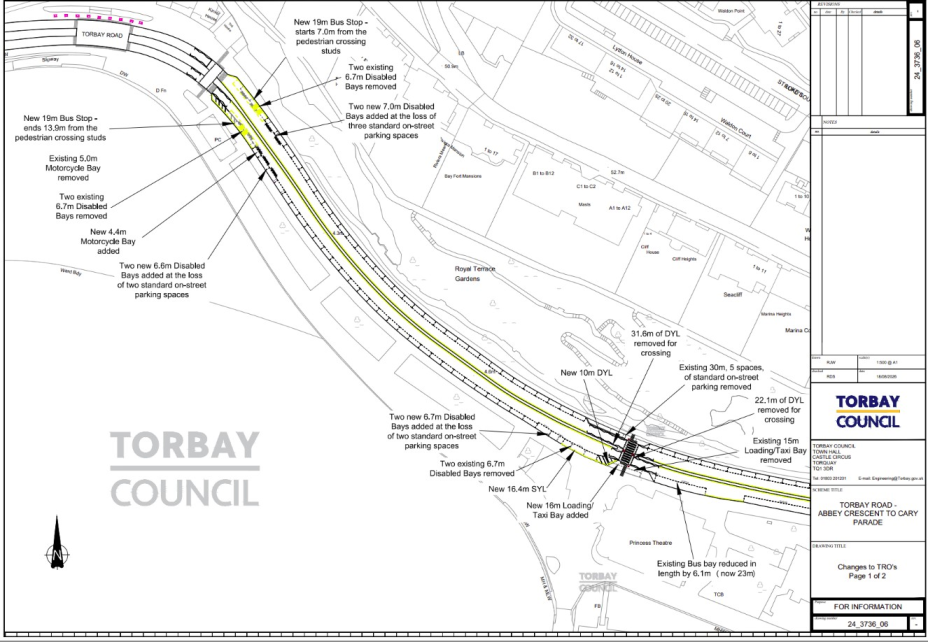
Map shows Torbay Road (Abbey Crescent to Cary Parade) with the location of:
- New 19 metres Bus Stop: ends 13.9 metres from the pedestrian crossing studs
- Existing 5.0 metres motorcycle Bay removed
- 2 existing 6.7 metres motorcycle Bay added
- 2 new 6.6 metres Disabled Bays added at the loss of 2 standard on-street parking spaces
- New 19 metre Bus Stop: starts 7.0 metres from the pedestrian crossing studs
- 2 existing 6.7 metres Disabled Bays removed
- 2 new 7.0 metres Disabled Bays added at the loss of 3 standard on-street parking spaces
- 2 new 6.7 metres Disabled Bays added at the loss of 2 standard on-street parking spaces
- 2 existing 6.7 metres Disabled Bays removed
- New 16.4 metres Single Yellow Line
- New 16 metres Loading/Taxi Bay added
- New 10 metres Double Yellow Line
- 31.6 metres of Double Yellow Line removed for crossing
- Existing 30 metres, 5 spaces of standard on-street parking removed
- 22.1 metres of Double Yellow Line removed for crossing
- Existing 15 metres Loading/Taxi Bay removed
- Existing Bus Bay reduced in length by 6.1 metres (now 23 metres)
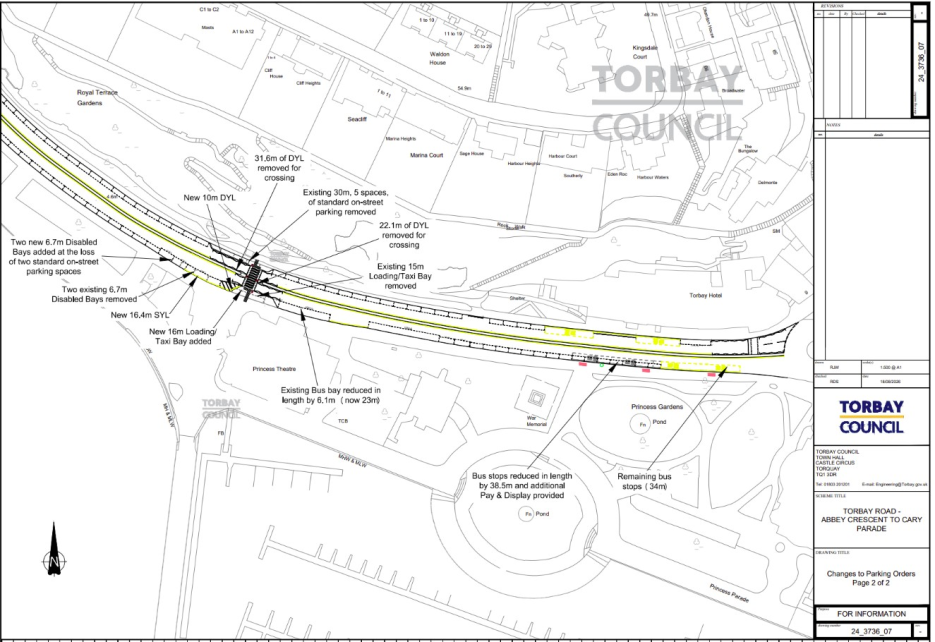
Map shows Torbay Road (Abbey Crescent to Cary Parade) with the location of:
- 2 new 6.7 metres Disabled Bays added at the loss of 2 standard on-street parking spaces
- 2 existing 6.7 metres Disabled Bays removed
- New 16.4 metres Single Yellow LIne
- New 16 metres Loading/Taxi Bay added
- New 19 metres Double Yellow Line
- Existing 30 metres, 5 spaces of standard on-street parking removed
- 22.1 metres of Double Yellow Line removed for crossing
- Existing 15 metres Loading/Taxi Bay removed
- Existing Bus Bay reduced in length by 6.1 metres (now 23 metres)
- Bus stops reduced in length by 38.5 metres and additional Pay and Display provided
- Remaining bus stops (34 metres)
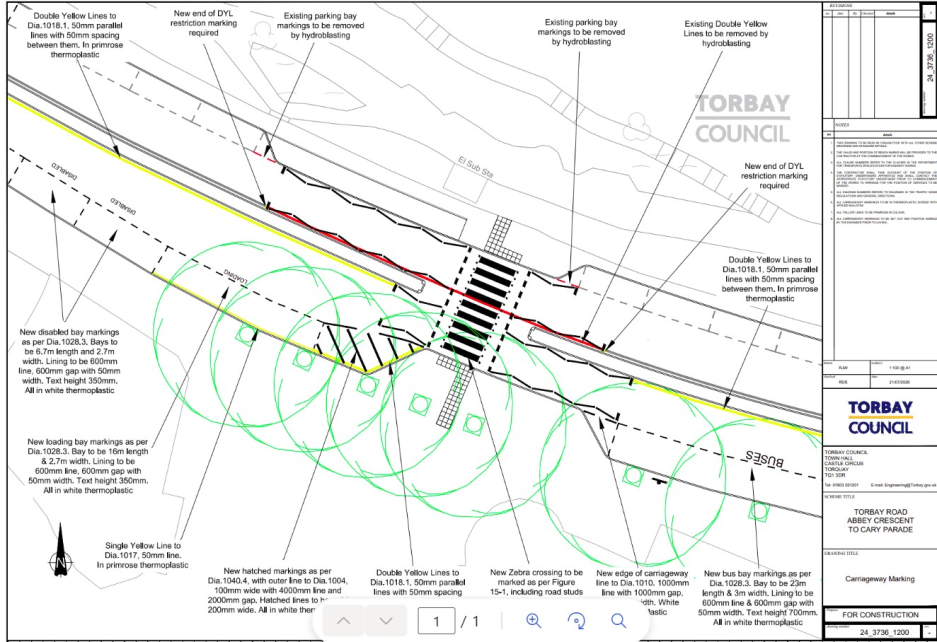
Map shows Torbay Road (Abbey Crescent to Cary Parade) with the location of:
- Double Yellow Lines to diameter 1810.1, 50mm parallel lines with 50mm spacing between them. In primrose thermoplastic.
- New end of Double Yellow Line restriction marking required.
- Existing parking bay markings to be removed by hydroblasting.
- Existing parking bay markings to be removed by hydroblasting.
- Existing Double Yellow Lines to be removed by hydroblasting.
- New end of Double Yellow Lines restriction marking required.
- Double Yellow Lines to Diameter 1018.1. 50mm parallel lines with 50mm spacing between them. In primrose thermoplastic.
- New disabled bay markings as per diameter 1028.3. Bays to be 6.7 metres length and 2.7 metres width. Lining to be 600mm line, 600mm gap with 50mm width. Text height 350mm. All in white thermoplastic.
- New loading bay markings as per Diameter 1028.3. Bay to be 16 metres length and 2.7 metres width. Lining to be 600mm line, 600mm fap with 50mm width. Text height 350mm. All in white thermoplastic.
- Single Yellow Line to Diameter 1017. 50mm line. In primrose thermoplastic.
- New hatched markings as per Diameter 1040.4, with outer line Diameter 1004, 100mm wide with 4000mm line and 2000mm gap.
Contact Parking
More in Parking
- Find a car park
- Pay a Penalty Charge Notice (parking ticket)
- Appeal a Penalty Charge Notice (parking ticket)
- Disabled parking
- Apply for or renew parking permits
- Car park charges
- Motorcycle parking
- On street parking (pay at meter)
- Pay by mobile (RingGo)
- Traffic Regulation Orders
- Campervan and motor home parking
- Residents Parking
- Electric Vehicle (EV) charging in car parks