Table of contents
- Why do we need a Strategy for Health & Wellbeing?
- Torbay at a glance
- Our vision
- What makes a healthy neighbourhood?
- How will we deliver our vision for neighbourhood health?
- What are the needs of our population?
- Activities required to address our population needs
- Identifying our priorities
- Principles underpinning our Strategy
- Our Strategy in summary
- Annual delivery plans
- How we will know if we are having an impact
- How we developed this Strategy
- Year 1 priority action areas
- References
What is a Health and Wellbeing Strategy?
A strategy to:
- address the needs and inequalities of our population and
- set out our strategic priorities for action.
Why do we need one?
To:
- improve health and wellbeing
- reduce inequalities
through working better together.
Who is involved?
All Health and Wellbeing Board partners, in consultation with our community.
How does it improve health and wellbeing?
- By informing local commissioning.
- By promoting integration between health and care, housing, economy, transport and environment.
Health and Wellbeing Boards bring together local authorities, health and care organisations, police, voluntary sector, and other partners, with the aim of improving health and reducing inequalities.
Every Health and Wellbeing Board is required to develop a Health and Wellbeing Strategy setting out the plan for improving the health and wellbeing of the local population. These will be very relevant to the expectations in the NHS 10 Year Plan for the development of neighbourhood health.
What could be more important than improving the health and wellbeing of our population?
Torbay at a glance
Torbay is a coastal community with comparatively high levels of deprivation, and strong natural and human assets.
Age profile
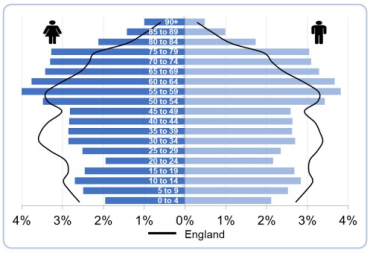
We have a significantly older age profile than England, with an average age of 49 compared with 40 nationally.
Torbay's population pyramid shows that for both men and women:
- there are fewer people younger than 49 on average than in England
- there are more people older than 50 on average than in England
Working age population
We have a much lower working age population than England and the South West.
Out of Torbay's total population of 139,485:
- 18% are under 18
- 55% are aged 18 to 54
- 27% are older than 65.
People over 65
1 in 3 of our residents will be aged 65 and over by 2033.
Median age
There is 23 years difference in the median age between King’s Ash and Wellswood wards.
In Kings Ash, the median age is 38 years.
In Wellswood, the median age is 61 years.
Life expectancy
How long we live varies significantly between men and women, and between the different wards in Torbay.
Women's average life expectancy is 83 years.
Men's average life expectancy is 78 years.
The life expectancy of people in the most deprived areas of Torbay is 8 years shorter than that of people living the least deprived areas.
Health conditions
Almost 1 in 4 of our residents have health conditions or disabilities that reduce their ability to carry out day-to-day activities. Numbers are much higher in our more deprived wards.
Healthy neighbourhoods where people of all ages can live, work and thrive.
My healthy neighbourhood
The following factors create a healthy neighbourhood:
- I am enabled to look after my health and wellbeing.
- I have a secure home, work and friends.
- My environment enhances my health and wellbeing.
- I know how to get help and support when I need it.
What makes a healthy neighbourhood?
What does national policy and strategy say?
Under the Government’s ‘Plan for Change’ there are five national missions to deliver a decade of national renewal. All five are relevant to our work as statutory and voluntary partners in Torbay, but there is particular resonance in the focus on economic growth, the NHS, and breaking down the barriers to opportunity through giving every child the best start in life.
In order to build an NHS fit for the future, the 10 year Health Plan for England refocuses health around three key shifts:
- Hospital to community
- Analogue to digital
- Sickness to prevention
These are supported by the creation of a neighbourhood health service in which all care should be as local as it can be - in the home if possible - and digital by default.
Healthy communities, or healthy places, are not new. With an emphasis on prevention, healthy neighbourhoods are a function of all the determinants of health working together to influence individual and community wellbeing.
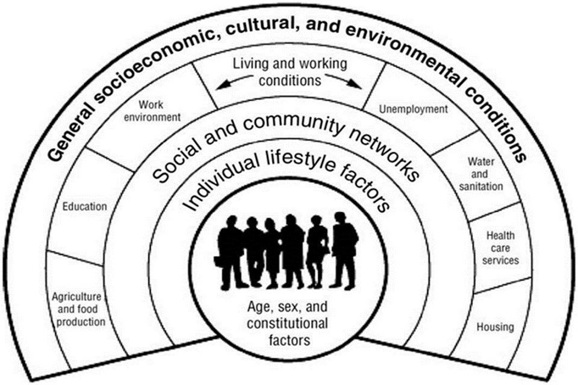
Figure 1: Dahlgren and Whitehead model of health determinants. (Source: Dahlgren and Whitehead, 1991).
Description of Figure 1: the Dahlgren and Whitehead model of health determinants
The model shows how a person's social and economic environment influences their health. At the core of the model is the person. Layers of influences surround them and determine their health.
The model shows the following layers:
- At the centre are personal characteristics, such as age and sex.
- Surrounding this are individual lifestyle factors, such as smoking and exercise.
- Surrounding this are social and community networks, such as family and friends.
- Surrounding this are living and working conditions, which include:
-
- Work environment
- Education
- Unemployment
- Water and sanitation
- Health care services
- Housing
- Agriculture and food productions
-
- Finally, general socioeconomic, cultural and environmental conditions, such as disposable income and availability of work.
Health and care services have a relatively minor influence on our health, with the greater impact from the way we live, and the environment we live in. And when the way we live is so heavily influenced by environmental factors, they indeed play by far the largest role.
The drivers of health are:
- Social and economic environment: 40% influence on health
- Health behaviour: 30% influence on health
- Clinical care: 20% influence on health
- Physical environment: 10% influence on health
"Neighbourhood health is not only, or even predominantly, the responsibility of health services. A response to these and similar problems requires the coordinated mobilisation of the assets in a community including communities themselves."
Department of Health and Social Care, July 2025
What constitutes a neighbourhood is not formally defined. A neighbourhood might be different things to different people, and to different organisations. The important thing is the move to local - wherever we live, work and spend our time - and the opportunity to develop local services and programmes in real collaboration with the people who live there.
What are our communities telling us?
Through engagement in Torbay and Devon to inform the NHS Long Term Plan, residents were asked what was important to them in terms of neighbourhood health. This is what they said.
Health promoting communities
Healthy communities are:
- Connected, with strong local networks and support systems
- Inclusive, especially for people with disabilities, older adults, and ethnically diverse communities
- Empowered, with access to information and the ability to shape services
Fair and easy access to support
We want to see:
- Better access to GPs and primary care
- Joined-up services across health, social care, and community support
- Equity in service provision, especially in coastal, rural, and deprived areas
- Digital inclusion:
- Technology should support - not replace - human care
- Services must remain accessible to those without digital skills or internet access
Enabling us to look after our own health
We support a shift from treating illness to preventing it, through:
- Health education in schools and communities
- Annual health checks, especially for older people
- Lifestyle support (e.g. healthy eating, exercise, smoking cessation)
- Screening services for early detection
- Not blaming individuals for poor health outcomes
Locally based care
We support moving care from hospitals into communities:
- Services closer to home – providing care that is community-based, accessible, personalised, and empowering
- Increased convenience, and earlier detection though community diagnostic centres and virtual wards
Support to look after our mental and emotional health
We want to see:
- Mental health support in schools
- Early intervention
- Listening to young people’s concerns
- More education around mental health and wellbeing
- Accessible community mental health services
Read the full NHS 10 Year Health Plan.
In summary
A healthy neighbourhood is somewhere where...
Health and care services
- go where people are
- are easy to access
- are enabling
- are designed in partnership
- start with prevention
Natural and built environments
- enhance wealth and wellbeing
- promote physical activity and social connections
Housing, employment, education and transport
- are suitable and secure
- promote health and wellbeing
- promote independence
- reduce inequalities
Citizens
- are in charge of their health and wellbeing
- are partners in their care
- are seen in their context
How will we deliver our vision for neighbourhood health?
This strategy is designed to influence the implementation of health and wellbeing improvement programmes through the following routes:
- Highlighting the needs in our population that all of us developing strategies, or commissioning services, must respond to.
- Summarising the areas of activity required to address our population needs, in the ways people have said they want to see.
- Identifying the priority areas we want to focus on as a Health and Wellbeing Board over the next four years.
- Describing the principles which underpin our Strategy and how it is implemented.
- Developing a decision framework to guide selection of Health & Wellbeing Board annual delivery programmes, sponsored by the Board, to deliver our priorities. These will be reviewed annually but a delivery programme may be continued through more than one year.
What are the needs of our population?
Our key challenges
Economy, housing and inequalities
- Torbay is ranked as the most deprived local authority in the South West and our economy is ranked among the weakest in England.
- Average wages are significantly below the regional and national average with less of the population in full-time employment than England.
- There is a continuing impact of the pandemic and persistent high cost of living, especially in utilities and food.
- Those who live in the most deprived areas of our communities are disproportionately affected.
- Torbay has a growing number of households experiencing fuel poverty. Old housing stock is particularly fuel inefficient.
- There is a consistent pattern of worse health and educational outcomes for those people who live in more deprived areas.
- There is significant variation in health and wellbeing across the bay.
- In our most affluent areas residents can expect to live on average almost eight years longer than those in our more deprived communities.
- There are significant gaps in healthy life expectancy (years in good health) between the most affluent and deprived areas.
Children and young people
- The number of cared for children within the local authority remains significantly higher than England. Rates of referrals to children’s social care are consistently much higher than England.
- Torbay schools have a significantly higher proportion of pupils requiring special educational needs support through an Education, Health & Care Plan than England although the gap has narrowed.
- Persistent pupil absenteeism remains at significantly high levels following the pandemic. Rates are much higher among children from our more deprived areas.
- Teenage pregnancies (under 18 years) have fallen over the last decade but are still higher than England.
- Our children have poor oral health. There are consistently high rates of hospital dental extractions among children due to dental decay, particularly among Torbay’s more deprived communities.
Working age adults
- The number of those who are of working age is projected to fall over the next 20 years to approximately 50% of the population from its current rate of 55%.
- A consistently high rate of people are homeless or threatened with homelessness.
- There are high levels of vulnerability in the population, including groups with specialist needs and high levels of mental ill health.
- There are consistently high levels of self-harm and suicide.
Older adults
- Torbay has high levels of need requiring support from Adult Social Care in the 18 to 64 population and also in the population over 65.
- We have very high rates of unpaid carers. The 2021 Census showed that there were 14,900 unpaid carers in Torbay. 5,185 of these provided 50 hours or more of care. This care is disproportionately provided by women.
- We have an ageing population with 1 in 3 Torbay residents expected to be 65 and over by the middle of the next decade. This will also put increasing demand on health and social care.
Protecting our health
- Screening and immunisation rates are lower than they need to be to protect our population from disease. There have been falls in breast and cervical cancer screening rates, childhood immunisation rates, and HPV vaccination rates in girls, since the pandemic.
Health behaviours
- Approximately 1 in 3 adults in Torbay are obese. 1 in 4 reception age children and more than 1 in 3 Year 6 children are overweight or obese.
- Around 1 in 6 adults in Torbay smoke.
- There are high levels of admissions to hospital related to alcohol, and high levels of preventable deaths from liver disease.
The needs in more details
More detail about the needs of our population can be found in the annual Joint Strategic Needs Assessment and Ward Profiles.
Activities required to address our population needs
These are the overall areas of activity required to address our population needs, in the ways people have said they want to see.
They are intended to be a guide for all of us developing strategies or commissioning services in Torbay.
Economy, housing and inequalities
- Take a poverty reduction approach in all policies.
- Ensure there are the jobs, skills, homes and culture in the Bay that make it attractive to live and work here.
- Start early – support the pipeline from education into employment.
- Recognise the links between health and wealth; focus on the determinants of health and wellbeing (jobs, homes, education) as well as access to health and care.
- In every intervention, consider the deprivation gradient – who has the poorest outcomes and the greatest need? Target interventions proportionately to reduce inequalities.
Children and young people
- Focus on prevention and enabling.
- Take a graded approach – from universal to targeted support when needed.
- Gather a team around the family to support healthy development for all our children.
- Maintain the ‘early help’ approach, getting the right support, when & where it is needed.
- Co-design interventions with those intended to benefit (for example, people with SEND, those who are care experienced).
- Develop interventions that will break the cycle of disadvantage, poor health and wellbeing.
- Improve access to good oral health; focus on prevention.
Working age adults
- Strengthen employment opportunities and skills for all age groups.
- Support and enable people who are out of work through ill-health back into employment.
- Develop sufficient housing for people to live and work in the Bay.
- Ensure health and care reach out into the community, going where people are.
- Make it normal to talk about mental health; promote resilience and confidence around the ways to wellbeing; increase access to information and support; expand peer support and training.
Older adults
- Take an enabling, ‘coaching’ approach, building on people’s strengths
- Think ‘home first’, enabling people to stay at home rather than go into hospital or long term care
- Focus on prevention; expand healthy ageing initiatives enabling people to build their physical, mental and social health & wellbeing
- Implement Age Friendly initiatives to promote healthy environments as we age, including housing, transport, planning, employment
- Support and enable carers to look after their own health & wellbeing
Protecting our health
- Increase uptake of immunisation and screening through targeted promotion and easier access
- Design delivery in partnership with groups or communities who have low uptake
Health behaviours
- Take a comprehensive approach: focus on healthy weight, healthy food, healthy environments
- Focus on enabling people to manage and improve their own health and wellbeing
- Start as early as possible – healthy and unhealthy behaviours are laid in childhood and in some cases before birth
- Focus on healthy places and spaces – family hubs, schools, green and blue spaces, workplaces, neighbourhoods
Identifying our priorities
The needs and activities outlined in this Strategy cover the full breadth of the health and wellbeing of our population.
To work towards our vision for healthy neighbourhoods, we have identified a priority approach which we as a Health and Wellbeing Board, together with our partners, want focus on for the next four years. This is intentionally quite broad, to allow for creative local approaches to improving neighbourhood health and wellbeing.
Our goal is to promote health and wellbeing through health promoting places.
This will involve:
- looking first at the causes of health and wellbeing, for example addressing the housing, financial, educational or employment situations that contribute to poor health
- detecting health problems early so they can be treated before they worsen, for example identifying high blood pressure and preventing future stroke
- taking an enabling approach, building on people’s strengths to promote their own health and wellbeing
- building on our South inequalities strategy to identify those who have the worst health outcomes and opportunities, and scaling our interventions to support and enable those who need most help the most
- targeting settings such as schools, homes or workplaces, or spaces such as town centres, transport systems or community areas.
Principles underpinning our Strategy
Approach
- An overarching strategic framework
- responding to the needs of the Joint Strategic Needs Assessment
- within the context of developing healthy neighbourhoods
- Annual priority delivery programmes where Health & Wellbeing Board will sponsor delivery
Priorities
- should respond to needs identified in the Joint Strategic Needs Assessment but not attempt to cover too many areas
- should be areas where multi-agency working is needed and where all members of the Health and Wellbeing Board have a role and can contribute
Delivery programmes
- should reduce health and social inequalities
- should be developed through a process of co-design with the populations who are intended to benefit
- should target health through the wider causes of poor health
Interventions
- should be based on good evidence and best practice
Outcomes
- should be measurable and meaningful to citizens
Healthy neighbourhoods where people of all ages can live, work and thrive.
Our vision
My healthy neighbourhood:
- I am enabled to look after my health and wellbeing
- I have a secure home, work and friends
- My environment enhances my health and wellbeing
- I know how to get help and support when I need it
Our aspirations for health promoting neighbourhoods
Health and Care services:
- go where people are
- are easy to access
- are enabling
- are designed in partnershp
- start with prevention
Natural and build environments
- enhance health and wellbeing
- promote physical activity and social connections
Housing, employment, education and transport
- are suitable and secure
- promote health and wellbeing
- promote independence
- reduce inequalities
Citizens
- are in charge of their health and wellbeing
- are partners in their care
- are seen in their context
Our priority approach
We will promote healthy neighbourhoods through a focus on preventing poor health, and enabling people to promote their own health and wellbeing, in the places where they live and work.
The principles underpinning our strategy
Our activities should:
• respond to needs identified in the Joint Strategic Needs Assessment
• be areas where multi-agency working is needed and where all members of the Health and Wellbeing Board have a role and can contribute
• reduce health and social inequalities
• be developed through a process of co-design with the populations who are intended to benefit
• target health through the wider causes of poor health
• be based on good evidence and best practice
• be measurable and meaningful to citizens
Annual delivery plans
This is the framework which we will use to guide the selection of Health & Wellbeing Board annual delivery programmes. Programmes will be reviewed annually but a priority programme may be continued through more than one year.
Annual delivery programme selection framework
Target population: children and young people
Areas of inequality or where intervention may be targeted for best effect:
- Care experienced
- With special educational needs & disabilities
- Caring for others
- In transition to adult
Target population: working age adults
Areas of inequality or where intervention may be targeted for best effect:
- Low-income households
- Not working through ill-health
- Caring for others
- Insecurely housed
Target population: older adults
Areas of inequality or where intervention may be targeted for best effect:
- Pre or prematurely frail
- Inactive or isolated
- Caring for others
- Approaching retirement
Needs identified in the Joint Strategic Needs Assessment
Economic
- Lack of jobs and skills
- Low incomes
- Unemployment through ill-health
- Insecure housing, unsuitable accommodation
- Fuel poverty
Dependency
- Levels of child and adult social care
- Special educational needs and disabilities
- Long term health conditions (prevention, early detection, management)
- Caring responsibilities
Mental and social health and wellbeing
- Poor mental health and wellbeing
- Suicide and self-harm
- Isolation
Health behaviours
- Alcohol
- Smoking
- Unhealthy weight
- Oral health
- Screening
- Vaccination
Assessing the programme or intervention
Neighbourhood approach
- How will it promote neighbourhood health?
Evidence base
- Is there quality evidence or best practice?
- Can we adopt learning from other sites?
- Or do we need primary research / test and learn?
Prevention first
- Is it taking a prevention approach?
Enabling approach
- Will the intervention build on people’s strengths to promote their own health and wellbeing?
Place
- What locations or settings are being targeted?
Inequalities
- How will the intervention tackle inequalities?
Partnership
- Do all partners have a role?
- Is there scope for co-design?
Added value
- Is there scope for innovation? Creativity? Doing things differently?
Outcomes
- Are there meaningful success measures?
How we will know if we are having an impact
The Joint Strategic Needs Assessment is our annual barometer of health and wellbeing in our communities and neighbourhoods across the Bay. Many of these measures are longer term, and will show us over time whether progress is being made.
Individual priority delivery programmes will have individual outcome measures. These will include national health indicators but also more short term local indicators agreed by partners. These should reflect the principles of the Strategy, being real and meaningful for those whom the intervention is designed to benefit.
How we developed this Strategy
This Strategy was developed in collaboration with members of the Torbay Health and Wellbeing Board with input from stakeholders including Local Authority, NHS, and Community and Voluntary Sector partners.
It was informed by insights from local community engagement and consultation with local residents.
It is based on the evidence of the Joint Strategic Needs Assessment for Torbay which sets out the health status of the population including the social and economic factors influencing our health.
Year 1 priority action areas
Priority 1: Healthy spaces
Target population: Children and young people
Needs
- Inequalities in opportunity
- Physical ill-health
- Low activity levels
- Poor diet
- Home or school insecurity
- Educational underachievement
- Unreadiness for work
Intervention/s
- Programme of activities to build physical, mental and social health and wellbeing
- Junior work placements
- Community led research into homeschooling
- Pipeline from education into work – via Coastal Navigators Network programme
- SEND/NEET coaching and mentoring programme
- Child Friendly Torbay priority areas including safe & secure environments and healthy lives
- Torbay on the Move Active Lives & Sports Strategy
Lead and co-design partners
- Community partnership, Play Torbay collaborative, Torbay Council
- Health and Wellbeing Board partners, NHS, VCSE
- Co-design with families and young people in the lead
Priority 2: Healthy spaces
Target population: Working age
Needs
- Population not working due to physical and mental ill-health
- NEETs
- Disparities in employment for people with SEND, those who are care experienced, and carers
Intervention/s
- Connect to Work programme with wraparound:
- NHS identification of people off work through ill-health
- NHS support for long term conditions (for example, mental health, musculo-skeletal)
- VCSE identification and support for those further from employment – confidence, mentoring, buddying, practical and social interventions
Lead and co-design partners
- Torbay Council and Local Care Partnership
- Health and Wellbeing Board partners, Employers, NHS, VCSE
- Co-design with target groups, for example, care experienced people
Priority 3: Healthy ageing
Target population: older adults
Needs
- Inequalities in life expectancy, frailty onset, ill-health and long term conditions, dependence on formal social care
- Social isolation
- Digital exclusion
- Carer inequalities in health and social wellbeing
- Housing insecurity
- Access to services and amenities
Intervention/s
- Age Friendly activities on housing, transport and health
- Torbay on the Move Active Lives and Sports Strategy
Lead and co-design partners
- Torbay Assembly, Torbay Council, Health & Wellbeing Board partners
- Co-design with older adults in Torbay
References
Joint Strategic Needs Assessment (JSNA) and Ward Profiles
10 Year Health Plan for England: fit for the future
Neighbourhood Health: The Idea Isn’t Radical But Implementing It Would Be
Shaping Places for Healthier Lives: about the programme
Delivering a neighbourhood health service: what the 10 Year Health Plan means for local integration
More in About the council
- How the council works
- Councillors
- Leader of the Council
- Get in touch
- Voting and elections
- Consultations
- Finance and budgets
- Plans, policies and strategies
- Information and data
- Civic Mayor
- Pay an invoice
- Report fraud within or against the council
- Audit
- Achievements, Honours and Awards
- Climate Change
- Our Performance
- Greener Way for Our Bay
- Customer Services and Call Centre