Content
- Best start family hubs
- Workforce capacity and capabilities
- Family involvement
- Monitoring, evaluation and learning
- System enablers gaps, actions and impact
- Accountability and governance
- Funding
This section outlines the system enablers that underpin the child development system, focusing on the Best Start Family Hubs network, the workforce and its capacity to deliver the ways in which families are involved in decision making‑ and share their views on child development. It identifies key gaps across each area, setting out priority actions, and describing the impact these actions are expected to achieve. It concludes with the governance arrangements that ensure accountability, and the financial and funding structures that support delivery.
Best Start Family Hubs
Current situation
In 2022, Torbay was awarded Department for Education funding to establish and develop Family Hubs, becoming one of only seventy‑four Local Authorities selected nationally. This investment has enabled Torbay to transform the way families access support, strengthening the ability to deliver targeted support to those who need it most. By bringing key services under one umbrella and ensuring shared ways of working, the hubs provide a central point for infant feeding support, parenting programmes, early language development, family relationships, mental health and wider wellbeing.
Torbay’s Family Hubs model places an emphasis on accessibility, offering both face-to-face and digital support, flexible drop‑ in sessions and a welcoming environment where families can access information, advice and specialist help. This integrated model supports Early Help, strengthening prevention, improving continuity of care‑ and ensuring families receive he right support at the right time.
What’s in place
Torbay has three Family Hubs, one located in each of the three towns that make up the area: Torquay, Paignton and Brixham. The Family Hubs have enabled Torbay to develop an early child development offer that is not only geographically well distributed but also strongly integrated across workforces. Services that once operated separately now work together around families, creating smooth pathways and more consistent support from pregnancy through early childhood.
A key strength of Torbay’s model is the co-location of services within the Hubs. Midwives, Health Visitors, Early Years teams, Early Help, Public Health Practitioners, Speech and Language Therapists and voluntary sector partners are all based on site with surgeries delivering support around cost-of-living including housing and benefits. As a result, families experience a joined up and coordinated offer rather than multiple disconnected contacts, with clearer communication, quicker referrals and a more holistic approach‑ to meeting their needs.
A blend of child development face-to-face, in‑ home, remote and digital support is offered so that families can access services in a way that works best for them. This flexibility helps ensure that families with different circumstances, preferences or barriers can still receive timely and appropriate help‑.
A peripatetic offer is also being developed to extend child development support into the wider community. This includes taking services into places where families spend their time, such as libraries, primary schools and Early Years settings. Strengthening these links will help broaden the reach and make support visible and accessible beyond the main Hub sites.
Referral pathways across the system are strong and increasingly integrated. Simple, clear referral and booking processes, both digital and in person, allow families and professionals to navigate support easily and ensure no one falls between services.
Torbay has invested in establishing a collaborative and trustworthy offer for families. Feedback often reflects that families do not distinguish between organisations but instead see the workforce as a single, unified team. This culture has been developed through strong working relationships, open dialogue and shared values across teams, helping ensure that families receive a seamless and supportive experience at every point of contact.
Workforce capacity and capabilities
Current situation
Torbay’s early years and Family Hubs workforce is broad, skilled and multi‑disciplinary. It encompasses professionals working across health, early education, family support, community development and specialist early years roles. It includes practitioners delivering universal services, targeted early help, and specialist interventions, supported by roles focused on coordination, quality assurance, workforce development and operational management. Working across settings and in people’s homes, the workforce ensures families receive timely, consistent and relational support.
A significant proportion of the workforce delivers direct, face‑to‑face support with families, including practitioners focused on early years development, family support, community outreach and system navigation. These roles are complemented by those providing business, administrative and operational support, which are essential to maintaining service continuity and ensuring the system functions efficiently.
What we have in place
The integrated workforce is a core strength of the local system, enabling coordinated support across maternity, health visiting, early years education, community venues, and targeted family support pathways.
Specialist expertise strengthens the universal and targeted offer. The workforce includes specialist practitioners with advanced skills in areas such as infant feeding, perinatal and infant mental health, emotional wellbeing, parenting support, early communication and language development, and child development. These roles help ensure evidence‑informed practice is embedded across Torbay’s Family Hubs and Early Years system.
Workforce capacity has been enhanced through investment in roles such as practice leads, early development specialists, community‑based family practitioners, and navigators who support families to engage with services. These roles help extend reach, particularly for families who may face barriers to accessing more formal services.
Collaboration is a key feature of the workforce model. Cross‑sector communication, joint planning forums, shared learning opportunities and aligned service approaches support consistent messaging and coordinated support for families. These structures enable practitioners from different organisations to work together with shared purpose and accountability.
Training and workforce development are supported through a blend of in‑house expertise, specialist practitioners, peer learning networks and external training partners. The local offer includes programmes such as Chat, Play, Read, Nurture Network, infant feeding training, and structured development pathways across the Early Years workforce.
Family involvement
Current situation
Family involvement is an established and valued part of Torbay’s early years system. Families regularly share their views through a mix of digital, in person and thematic engagement, and these insights increasingly shape how Family Hub services are delivered. Parents are becoming more confident in taking part in discussions about support, contributing to local learning, and participating in community‑ led‑ activity. The workforce is experienced in building relationships with families, helping ensure that lived experience is recognised as an essential driver of Best Start in Life improvement.
What’s in place
Torbay has a structured and varied approach to gathering insight and feedback from families, with multiple mechanisms designed to capture feedback across different points in a family’s journey. A quarterly thematic cycle guides deeper engagement on priority topics such as the home learning environment, infant feeding, parenting and emotional wellbeing. Additional ad hoc insight is gathered on inclusivity, child development, safety and the day-to-day‑ experience of using Family Hubs.
A wide range of tools support this activity. Social media, QR codes, digital surveys and brief questions through the Family Hub sign in‑ app enable families to provide quick feedback. Chromebooks and mobile devices help staff collect digital feedback directly in community venues, reducing barriers for families who may not have reliable access to technology at home.
The family involvement model is strengthened by trusted relationships. Practitioners, community champions and parent connectors engage families and support conversations with those who may be less likely to participate in formal feedback processes.
Parents are also taking more active roles within Family Hubs. Peer led groups and parent‑ initiated‑ activities, such as loneliness support groups and informal peer networks are also becoming more common and contribute to a strong sense of shared ownership. Torbay also gathers insight through learning partnerships and research activity, including work on relationships, wellbeing and financial resilience, and through regional maternity and neonatal networks.
Monitoring, evaluation and learning
Current situation
Part of the success of Torbay’s Family Hubs programme can be attributed to the improvements made in data sharing across the local system. Stronger collaboration between services has enabled timelier and more coordinated support for families, while also reducing duplication. Clear data sharing arrangements set out defined roles and responsibilities from the outset, ensuring that each partner understands their function within the wider system and that information is handled safely and consistently.
As collaboration across the Early Years system has strengthened, shared data is increasingly used to inform strategic planning, helping services identify what is working well, where gaps exist, and how different communities across Torbay experience early years support.
What’s in place
Torbay has a system in place to ensure all BSiL services have a mechanism to gather parent carer feedback with sign in‑ data, surveys and participation tracking helping to measure service reach and effectiveness.
Early education data, such as attendance patterns, speech and language information and participation in early learning activities adds insight into children’s progress. Feedback and outcomes from parents and carers are collected before and after interventions, supported by parent panels, group discussions and tailored feedback tools mapped to recognised outcomes frameworks.
Contact information is updated regularly to ensure effective communication with families. Families are registered at their first point of contact with the Family Hub, either in person, online or via outreach. Each service interaction is recorded through the sign in system and shared across eStart and Public Health Nursing systems.
A comprehensive system is in place to draw data together from different IT and case management‑ systems, allowing information from multiple early years services to be viewed and interpreted as a cohesive picture.
A wide range of early years data is routinely collected to provide a clear picture of communities and service use. Demographic information is collected consistently, including age, gender, ethnicity, household composition, socio‑economic indicators and languages spoken at home. In addition, service access, health and development data, early education participation and parent carer feedback are all collected and monitored.
Health Visitor mandated contacts from pregnancy to the 2.3‑year review provide reliable touchpoints for understanding family circumstances and emerging needs. Health and development data includes ASQ-3. Early Language Identification Measure (ELIM) results, and referrals to specialist services.
Data is collected by service leads across commissioned services and the Local Authority, submitted and quality assured‑ by Business Intelligence before final sign‑off by senior leaders. A repeatable quarterly reporting cycle is embedded within a Corporate Reporting Framework.
The move to the single ‘EPIC’ case management system from April 2026 will support more consistent case recording and provide practitioners with a unified view of each family’s journey.
System enablers gaps, actions & impact
Best Start Family Hubs gaps, actions & impact
Gap 1
Families who do not routinely access Best Start Family Hub services including families from Torbay’s most derived areas, young parents and families with EAL.
Actions
- Codesign targeted outreach using cultural, linguistic and community l‑ed insights.
- Targeted outreach to connects families to EYFS aligned‑ developmental support including Chat, Play, Read, Numbers, Fine and Gross Motor Skills.
Impact
- Increase in the % of families accessing early support.
- Increase in the number of families and children engaged in and successfully completing programmes.
- Increased GLD attainment.
- Reduction in GLD inequalities.
Gap 2
The current ‘spoke’ offer is under‑developed, limiting access through community settings.
Actions
- Expand spoke delivery by increasing provision in libraries, primary schools, Early Years settings, community centres, and voluntary sector‑ venues.
- Embed early development EBIs into the spoke offer.
Impact
- More families accessing early development support closer to home.
- Increase in the number of families and children engaged in and successfully completing programmes.
- Increased GLD attainment.
- Reduction in GLD inequalities.
Workforce capacity and capabilities gaps, actions and impact
Gap 1
Current workforce is not fully aligned to delivering EBIs to meet the GLD targets
Actions
- Strengthen the Community Champion and Parent Connector roles to support the government approved HLE and Parenting EBIs.
- Embed child development aligned messages at all universal and targeted contacts.
Impact
- Increase in the number of families and children engaged in and successfully completing EBIs.
- Increased GLD attainment.
- Reduction in GLD inequalities.
Gap 2
Workforce training for government approved EBIs supporting child development is inconsistent
Actions
- Develop a workforce training offer for government approved EBIs.
Impact
- Increase in the number of staff trained in delivering EBIs.
- Increase in the number of families and children engaged in and successfully completing EBIs.
- Increased GLD attainment.
- Reduction in GLD inequalities.
Family involvement gaps, actions and impact
Gap 1
Priority families are under-represented on parent carer panels
Actions
- Actively recruit parent carers from priority cohorts.
Impact
- Increased representation of families in parent carer panels from priority cohorts.
- Broader range of lived experience influencing child development support pathway
- Improved early years decision making‑ that reflects diverse needs, supporting progress toward GLD.
Gap 2
Co-production of services does not fully involve the groups least represented in services including families from Torbay’s most deprived areas, families with EAL and young parents.
Actions
- Increase involvement of priority cohorts through Community Champions and Parent Connectors.
- Develop flexible, accessible co‑production activities that fit families’ needs.
Impact
- Increase in the number of co-produced provisions, specifically from priority cohorts.
- Services are better aligned with the needs of diverse families, improving engagement in early learning activities that support GLD.
Gap 3
Parent-led quality assurance is underdeveloped.
Actions
- Develop and implement a parent led‑ quality assurance model.
- Embed findings into continuous improvement cycles.
Impact
- Increase in the number of parent led‑ quality assurance activities.
- Stronger, real time‑ insight into family experience across Family Hub services.
- Improved quality, responsiveness and equity of early years services, strengthening conditions for early development and GLD outcomes.
Data, monitoring and learning gaps, actions and impact
Gap 1
Limited analytical capacity restricts the ability to turn data into actionable insight.
Actions
- Build analytical capacity across teams to translate insight into early intervention.
- Develop an integrated early years Power BI dashboard to support real time‑ analysis.
Impact
- Improved ability to identify trends, inequalities and emerging needs.
- Increase in the number of families accessing support earlier, strengthening pathways towards GLD.
- Increased GLD attainment.
- Reduction in GLD inequalities.
Gap 2
Multiple digital systems require manual collation, limiting efficiency.
Actions
- Implement EPIC and create a shared early years data model for automated flows.
- Align digital systems to track developmental progress, service use and outcomes
Impact
- More reliable and consistent data across partners.
- Improved real‑time monitoring of early years activity.
- Improved ability to intervene early where children may fall behind GLD domains.
- Increased GLD attainment.
- Reduction in GLD inequalities.
Gap 3
Parent feedback is collected but not consistently acted on.
Actions
- Embed routine feedback loops across all workstreams
- Use insight to refine early development messaging, access routes and service design and delivery.
Impact
- Clearer demonstration of how parent voice shapes decisions and services.
- Increased trust and engagement from families.
- More responsive services tailored to family‑identified priorities.
Accountability and governance
Torbay’s governance structure provides a strong foundation for oversight and accountability, ensuring that work to improve outcomes for children and families is well coordinated and aligned across the system. A Best Start in Life (BSiL) Board has been operational since October 2026 and provides strategic leadership for the programme, supporting collective progress towards achieving Torbay’s targeted GLD outcomes.
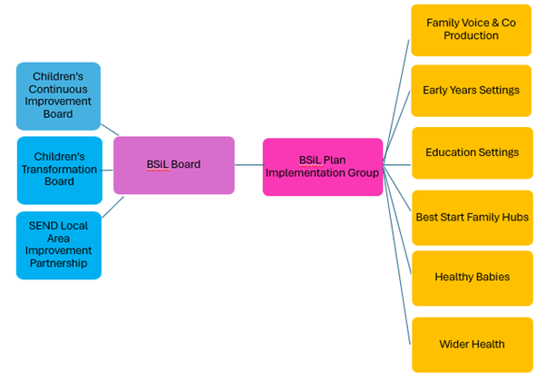
The governance arrangements promote multiagency ownership, shared responsibility and system-wide improvement. They also ensure that evidence, insight and lived experience shape decision making and that services remain focused on delivering high quality, equitable support across the early years system. Figure 6 illustrates how governance is organised across Torbay’s Best Start in Life programme.
Figure 6: Torbay’s Best Start in Life Governance Structure
This diagram shows the governance structure for the Best Start in Life (BSIL) programme.
On the left, three boards feed into the BSIL Board: the Children’s Continuous Improvement Board, the Children’s Transformation Board, and the SEND Local Area Improvement Partnership.
The BSIL Board connects to the BSIL Plan Implementation Group.
On the right, the BSIL Plan Implementation Group links to seven work areas:
- Family Voice & Co‑Production
- Early Years Settings
- Education Settings
- Best Start Family Hubs
- Healthy Babies
- Wider Health
Funding
The available resources, including the Best Start in Life and Healthy Babies grants, the Public Health Ringfenced Grant, and Local Authority resource are being aligned to support the effective delivery of the BSiL Plan.
Best Start funding will be prioritised to support the delivery of EBIs for 3‑ and 4‑year‑olds, increasing reach among priority cohorts, addressing inequalities in GLD attainment, and contributing to overall improvements in GLD outcomes.
Best Start Family Hubs and Healthy Babies funding will be distributed between 2026 and 2029 in line with Department for Education allocation guidance and the percentage breakdown outlined in Table Three.
| Strand | % | How resource will be spent |
|---|---|---|
| Best Start Family Hubs delivery grant - programme | 25% | Supporting strategic oversight and strengthening family involvement to ensure services remain on track and are equipped to contribute towards meeting GLD targets. |
| Best Start Family Hubs delivery grant - capital | 6% | Maintaining and enhancing Family Hubs and spoke sites so they offer a welcoming, accessible environment for families. |
| Parenting support | 12% | Increasing and expanding delivery of EBIs that equip parents and caregivers with the skills, knowledge and confidence to positively influence their child’s development at ages 3 and 4, supporting readiness for school. |
| Home Learning Environment Support | 10% | Increasing and expanding HLE‑focused EBIs to help parents and carers use practical strategies and activities that strengthen the quality of learning interactions in the home. |
| Perinatal Mental Health and Parent Infant Relationships | 29% | Continuing to provide tailored and targeted support for families including partners and co parents on mild to moderate perinatal mental health needs and parent–infant relationship support, contributing to early development and positive GLD outcomes. |
| Infant Feeding support | 17% | Continuing to offer tailored and targeted breastfeeding and infant feeding support, enabling families to make informed feeding choices while optimising breastfeeding, strengthening early attachment and supporting child development towards GLD. |
| Healthy Babies offers and Parent Carer Panels | 2% | Promoting the Healthy Babies offer widely and expanding the Parent Carer Panel approach to ensure representation from priority cohorts. |
Contact Family Information Service
More in Children and families
- Services and support
- Private fostering
- Peninsula Commissioning and Procurement Partnership
- Celebration Event May 2022
- Our Ways of Working
- Fostering
- Home learning environment and early years
- UNICEF Child Friendly Community
- Participation groups for young people
- Torbay Safeguarding Children Partnership Training
- Corporate Parenting
- Care Experienced local offer
- Corporate Parenting Strategy 2025/28
- Ofsted inspection 2026
- World Social Work Day 2026
- Best Start in Life Plan