Contents
Targets
Torbay’s target is that by 2028, 77.8% of children overall and 61.6% of children accessing Free School Meals (FSM) reach a Good Level of Development (GLD) by the end of Early Years Foundation Stage (EYFS), or age five. This equates to 101 additional children achieving GLD overall and 23 additional children achieving GLD on Free School Meals (FSM) by 2028, see table one below.
Table 1: Torbay’s GLD Targets 2024 - 2028
| Year | All Children reaching GLD — Percentage | All Children reaching GLD — Number | FSM Children reaching GLD target — Percentage |
|---|---|---|---|
| 2024/2025* | 68.5% | 749 | 50.7% |
| 2025/2026 | 71% | 776 | 55% |
| 2026/2027 | 74% | 809 | 58% |
| 2027/2028 | 78% | 850 | 62% |
* 2024/2025 figures represent actual performance, not targets
Table two shows the projected number of children not expected to reach a GLD over the next three years, based on Torbay’s falling birth rate. It compares outcomes if performance stays at the current 68.5% rate with Torbay meeting its yearly targets. Children in the second column represent those most likely to require targeted support, identified through Torbay’s data on groups least likely to achieve a GLD.
Table two: Projected number of Torbay children not expected to achieve a GLD by the end of EYFS.
| Year | No of children not expected to reach a GLD based on current achievement rate of 68.5% | No of children not expected to reach a GLD based Torbay meeting the yearly set targets |
|---|---|---|
| 2025/2026 | 330 | 304 |
| 2026/2027 | 320 | 264 |
| 2027/2028 | 307 | 216 |
Current position
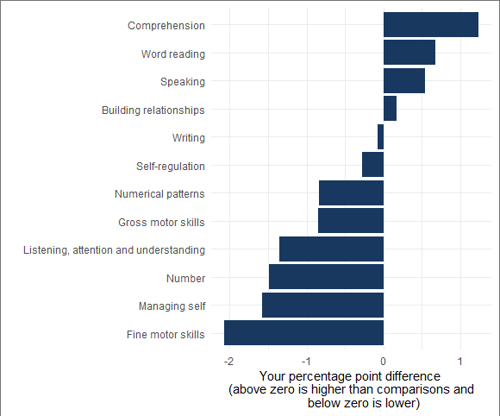
By reviewing the Early Learning Goals (ELGs) which are the individual measures that contribute to GLD, a more granular understanding of those areas where Torbay has a good foundation as well as where greater focus is needed (fig. 1). Torbay’s strongest areas are in comprehension, word reading and speaking, which sit at or above national levels. The greatest gaps are in fine motor skills, managing self, number, listening and attention, and early maths related goals. These domains require focused improvement to accelerate progress towards GLD targets. Figure one: Percentage of pupils reaching each early learning goal (ELG) in Torbay compared with national averages for the 2024 to 2025 academic year.
This chart compares Torbay’s Early Learning Goal results with a comparison group.
A value above zero means Torbay performed better; a value below zero means Torbay performed worse.
- Torbay performs better than the comparison group in:
- Comprehension
- Word reading
- Speaking
- Building relationships (slightly)
- Writing (slightly)
- Torbay performs worse than the comparison group in:
- Self‑regulation
- Numerical patterns
- Gross motor skills
- Listening, attention and understanding
- Number
- Managing self
- Fine motor skills (largest gap)
Source: Early Years Foundation Stage Profile 2024/25 results for your local authority and national 2024/25 data from the DfE
Fine motor skills show the biggest negative difference (around –2 percentage points). Comprehension shows the biggest positive difference (just over +1 percentage point).
Different groups of children in Torbay achieve a GLD at different rates. Boys, children with an Education, Health and Care Plan (EHCP), and children with no identified special educational needs perform slightly above national averages, despite these groups typically performing less well nationally. Children who speak English as an Additional Language (EAL) show the largest gaps compared with their peers and remain well below national levels, highlighting the need for focused attention. Children eligible for free school meals (FSM) also continue to fall slightly behind.
Ages and Stages Questionnaires (ASQ3), used at the Health Visitor led 2.3 year developmental review, show that although Torbay achieves very high coverage, (98.6% of children received an ASQ3), outcomes across all five developmental domains are below national levels. Torbay records children who score in the “grey” band just below the expected level as not meeting expectations. Nationally, however, children scoring in the grey band are generally classified as meeting the expected level. This difference in reporting means Torbay appears to perform significantly below national averages. In practice, though, children in Torbay who fall within the grey band or lower are provided with additional intervention.
Table three: ASQ-3 data for Torbay and England 2024 - 2025
| Year 2024/2025 | Torbay % at or above expected level | England % | Difference (Torbay Vs England) |
|---|---|---|---|
| Overall (all five areas) | 70.7% | 81.4% | 10.7 pp |
| Communication | 82.9% | 87.5% | 4.6 pp |
| Gross Motor | 86.8% | 93.6% | 6.8 pp |
| Fine Motor | 84.6% | 93.7% | 9.1 pp |
| Problem Solving | 87.9% | 93.0% | 5.1 pp |
| Personal‑Social | 84.0% | 92.3% | 7.7 pp |
Data analysis of GLD outcomes at both ward level and individual school level make it clear where the children who are not reaching their developmental milestones live in Torbay and which settings they will attend. This enables support to be targeted with much greater precision.
How children’s progress will be tracked
The table below sets out how Torbay will systematically track children from birth to age five to monitor progress toward GLD targets. It shows the key data sources used at each stage, who holds that data, how it will be gathered and interpreted, and how the information will trigger targeted interventions.
Table four: Tracking mechanisms for children at risk of not achieving GLD
| Stage of tracking | What data is used | Who holds the data | How data is collected, collated and analysed |
|---|---|---|---|
|
Early Identification (Ages 0–4)
|
|
|
|
|
Pre‑school
|
|
|
|
|
Reception Baseline & In‑year EYFS Checks
|
|
|
|
|
End of Reception Year
|
|
|
|
Contact Family Information Service
More in Children and families
- Services and support
- Private fostering
- Peninsula Commissioning and Procurement Partnership
- Celebration Event May 2022
- Our Ways of Working
- Fostering
- Home learning environment and early years
- UNICEF Child Friendly Community
- Participation groups for young people
- Torbay Safeguarding Children Partnership Training
- Corporate Parenting
- Care Experienced local offer
- Corporate Parenting Strategy 2025/28
- Ofsted inspection 2026
- World Social Work Day 2026
- Best Start in Life Plan