Contents
- Home learning environment interventions
- Parent interventions
- Early childhood education and care access and quality
- Transition to school and reception year
- SEND support
- Early child development gaps, actions and impact
This section examines Torbay’s Early Child Development system, which includes the Home Learning Environment (HLE), Parenting Programmes, Early Years Access and Childcare Provision, Transition to School and Reception year and SEND provision. It outlines what is currently in place within each component of the system and concludes with a summary of the identified gaps, the actions that will address these gaps, and the impact this will have on child development.
Home Learning Environment interventions
Current situation
Since receiving Family Hubs funding in 2022, the HLE offer has continued to evolve, extending across Public Health Nursing, Early Years, Family Hubs, the NHS, and local community and voluntary sector partners. In response to the developmental challenges faced by children in Torbay, including a marked rise between 2020 and 2025 in Education, Health and Care Plan (EHCP) applications for children aged five to ten, see figures four and five, an Early Years Pathway was developed and implemented. This pathway ensures that children’s needs are identified as early as possible and that a strong, coordinated package of support is delivered consistently across the Early Years sector.
Bar chart showing the number of EHCPs in Torbay from 2020 to 2025. Numbers rise from 1,416 in 2020 to 1,643 in 2025, with some year‑to‑year variation.
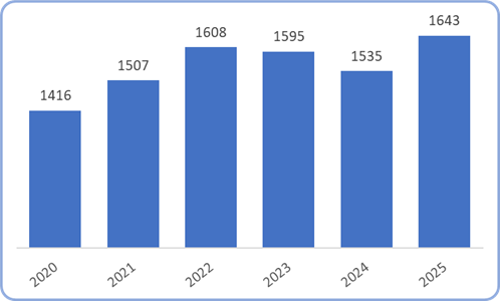
| Year | Number |
|---|---|
| 2020 | 1,416 |
| 2021 | 1,507 |
| 2022 | 1,608 |
| 2023 | 1,595 |
| 2024 | 1,535 |
| 2025 | 1,643 |
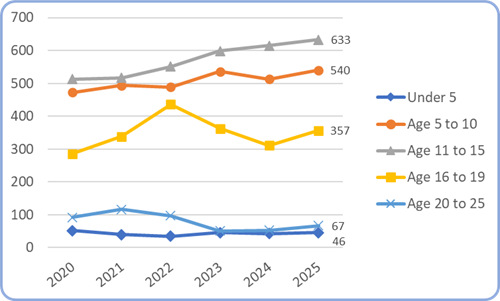
Summary of trends (2020–2025):
- Ages 11–15 have the highest and steadily increasing number of EHCPs, rising from 540 in 2020 to 633 in 2025.
- Ages 5–10 also show a gradual rise, ending at 540 in 2025.
- Ages 16–19 fluctuate sharply, peaking at 433 in 2022 before dropping to 357 in 2025.
- Under‑5s remain low, between 46–67 across all years.
- Ages 20–25 stay consistently low and stable.
| Year | Under 5 | Age 5 to 10 | Age 11 to 15 |
|---|---|---|---|
| 2020 | 46 | 478 | 540 |
| 2021 | 67 | 499 | 570 |
| 2022 | 50 | 510 | 600 |
| 2023 | 55 | 540 | 633 |
| 2024 | 67 | 499 | 620 |
| 2025 | 67 | 540 | 633 |
What’s in place
Torbay is embedding its HLE approach through consistent, evidence based key messages focused on Chat, Play, Read, using a ‘pass it on’ model. Training, resources and locally tailored messages have been developed and shared with key professionals and partners through training sessions and networks, who then cascade these messages to families across the area. Additional physical and digital resources are also available to support direct communication with families.
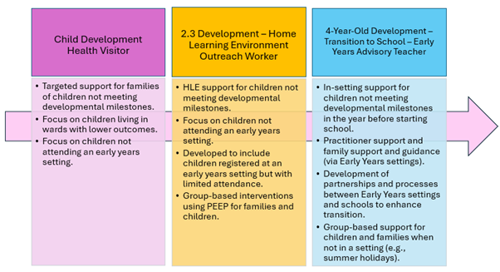
Diagram three below illustrates a targeted early identification and support pathway within the Best Start Family Hubs framework, structured around three key developmental stages: 1 year, 2.3 years, and 4 years. Across all stages, the approach is underpinned by consistent messaging promoting Chat, Play, Read, and the importance of the Home Learning Environment.
Figure six: Early Identification of Need – targeted support
Child Development Health Visitor
- Targeted support for families of children not meeting developmental milestones.
- Focus on children living in wards with lower outcomes.
- Focus on children not attending an early years setting.
2.3 Development – Home Learning Environment Outreach Worker
- HLE support for children not meeting developmental milestones.
- Focus on children not attending an early years setting.
- Developed to include children registered at an early years setting but with limited attendance.
- Group-based interventions using PEEP for families and children.
4‑Year‑Old Development – Transition to School – Early Years Advisory Teacher
- In‑setting support for children not meeting developmental milestones in the year before starting school.
- Practitioner support and family support and guidance (via Early Years settings).
- Development of partnerships and processes between Early Years settings and schools to enhance transition.
- Group‑based support for children and families who are not in a setting (e.g., summer holidays).
The Child Development Health Visitor provides targeted support for families where children are not expected to meet their 1‑year and 2.3‑year developmental milestones. The role focuses on children living in areas with lower outcomes and on those not attending an Early Years setting, ensuring they are identified early and referred into the Early Years Pathway.
The HLE Outreach Worker delivers targeted support for children who are not meeting developmental milestones at their 2.3 ASQ3 assessment, particularly those not attending an Early Years setting or attending with limited consistency. The role strengthens practitioner understanding of the importance of the home learning environment and delivers PEEP‑ based‑ group interventions and Chat, Play, Read support for families.
The Early Years Advisory Teacher provides insetting support for children who are not meeting developmental milestones in the year before school. The role focuses on practitioner guidance, strengthening partnerships between Early Years settings and schools, and supporting high‑ quality transitions. Additional group‑ based‑ work is offered during periods when children are not in a setting, such as the summer holidays, ensuring continued access to developmentally supportive activities.
HLE services have been developed based on identified needs of children and their families. Through the Home Visiting service, it was established that many families were experiencing levels of anxiety on leaving the home which was stopping them accessing the wider support offer of the Family Hubs. In response these families were invited to smaller, evidenced based PEEP workshops delivered by the HLE Outreach worker. These sessions help families build confidence, develop relationships with peers, and connect with staff and volunteers. Workshops focus on supporting parent–child communication and interaction and are offered weekly in Family Hubs and community venues.
A comprehensive suite of training and resources has been created to reinforce Torbay’s Chat, Play, Read messaging. Practitioners across Public Health Nursing, Action for Children, Early Years settings and libraries have received training, and a dedicated section of the Family Hub website promotes these resources to families. Targeted engagement has taken place in areas of higher deprivation, including attendance at community led coffee mornings in local venues, schools and Early Years settings.
A collaborative programme involving Public Health Nursing and Early Years providers led to the development of a local Early Years Development Pathway, incorporating both the ASQ3 assessment at the 2.3 year development review and the Progress Check at age two. This pathway strengthens early identification of need and ensures coordinated support for children and families, including interventions delivered in Early Years settings and the home.
Across the Family Hub network, a range of groups, including Thriving Child and Little Explorers, offer opportunities for children and families to engage in activities that support child development. These groups also provide advice and guidance on supporting learning within the home environment.
One-on-one Talk and Play Sessions offer tailored advice to families on supporting their child’s communication and language development. Referral pathways between these sessions and PEEP groups ensure families continue to receive appropriate support once individual sessions have ended.
Parenting interventions
Current situation
Torbay’s Family Hubs parenting programme has been operational since the introduction of Family Hubs funding in 2022 and is now a well-established part of the early years system. The programme is built around Early Help principles, offering timely, accessible support to families and helping to prevent challenges from escalating. Parenting support is delivered through a coordinated partnership of services working across Family Hubs, early years settings and health and community providers, ensuring families receive help that is consistent and tailored to their needs.
The programme places strong emphasis on building parental confidence, strengthening parent–child relationships and supporting positive home environments that contribute to early development and improved long-term outcomes. A wide range of DfE approved evidence-based interventions (EBIs) are available, reflecting the diverse needs of families across Torbay, from universal guidance for all parents, to more targeted and intensive support for families experiencing additional challenges.
What’s in place
Torbay delivers a wide range of parenting support spanning pregnancy, the early years and middle childhood, with coordination improving as the system continues to develop. Support begins in the antenatal period through Solihull Antenatal groups, followed by postnatal Solihull groups delivered both in Family Hubs and community settings.
Parents can access a full suite of online Solihull courses and bitesize videos through the Family Hub website, providing flexible support alongside in person group delivery.
A newly appointed Parenting Lead within Public Health Nursing is helping to strengthen coordination and ensure families are consistently linked to appropriate parenting pathways and are supported specifically with child development.
Portage delivers weekly Small Steps sessions for children with emerging developmental needs, while PEEP groups and Family Wellbeing activities support early learning, relationships and parental confidence.
Community outreach events across early years settings, Family Hubs and wider settings promote Early Help, Solihull and other parenting offers, helping parents understand available support and how to access it.
Reducing Parental Conflict sessions and programmes such as Standing Tall offer further support for families experiencing relationship difficulties or requiring additional help to maintain a stable and nurturing home environment.
Across all ages, Torbay provides targeted one-to-one interventions through Early Help and Family Support pathways, including Triple P Baby, Video Interaction Guidance, Incredible Years Pre-School and one-to-one Solihull parenting. These EBIs allow practitioners to tailor support to families who require more intensive or therapeutic help, ensuring a continuum from universal advice through to structured relational interventions. Parenting support is matched to need through the Family Help Panel, helping reduce duplication and ensuring families receive timely, appropriate support.
An annual programme of Solihull training and facilitator development maintains delivery capacity across the workforce, enabling consistent, evidence informed practice.
HLE services have been developed based on identified needs of children and their families. Through the Home Visiting service, it was established that many families were experiencing levels of anxiety on leaving the home which was stopping them accessing the wider support offer of the Family Hubs. In response these families were invited to smaller, evidenced based PEEP workshops delivered by the HLE Outreach worker. These sessions help families build confidence, develop relationships with peers, and connect with staff and volunteers. Workshops focus on supporting parent–child communication and interaction and are offered weekly in Family Hubs and community venues.
A comprehensive suite of training and resources has been created to reinforce Torbay’s Chat, Play, Read messaging. Practitioners across Public Health Nursing, Action for Children, Early Years settings and libraries have received training, and a dedicated section of the Family Hub website promotes these resources to families. Targeted engagement has taken place in areas of higher deprivation, including attendance at community led coffee mornings in local venues, schools and Early Years settings.
A collaborative programme involving Public Health Nursing and Early Years providers led to the development of a local Early Years Development Pathway, incorporating both the ASQ3 assessment at the 2.3 year development review and the Progress Check at age two. This pathway strengthens early identification of need and ensures coordinated support for children and families, including interventions delivered in Early Years settings and the home.
Across the Family Hub network, a range of groups, including Thriving Child and Little Explorers, offer opportunities for children and families to engage in activities that support child development. These groups also provide advice and guidance on supporting learning within the home environment.
One-on-one Talk and Play Sessions offer tailored advice to families on supporting their child’s communication and language development. Referral pathways between these sessions and PEEP groups ensure families continue to receive appropriate support once individual sessions have ended.
Parenting interventions
Current situation
Torbay’s Family Hubs parenting programme has been operational since the introduction of Family Hubs funding in 2022 and is now a well-established part of the early years system. The programme is built around Early Help principles, offering timely, accessible support to families and helping to prevent challenges from escalating. Parenting support is delivered through a coordinated partnership of
services working across Family Hubs, early years settings and health and community providers, ensuring families receive help that is consistent and tailored to their needs.
The programme places strong emphasis on building parental confidence, strengthening parent–child relationships and supporting positive home environments that contribute to early development and improved long-term outcomes. A wide range of DfE approved evidence-based interventions (EBIs) are available, reflecting the diverse needs of families across Torbay, from universal guidance for all parents, to more targeted and intensive support for families experiencing additional challenges.
What’s in place
Torbay delivers a wide range of parenting support spanning pregnancy, the early years and middle childhood, with coordination improving as the system continues to develop. Support begins in the antenatal period through Solihull Antenatal groups, followed by postnatal Solihull groups delivered both in Family Hubs and community settings.
Parents can access a full suite of online Solihull courses and bitesize videos through the Family Hub website, providing flexible support alongside in person group delivery.
A newly appointed Parenting Lead within Public Health Nursing is helping to strengthen coordination and ensure families are consistently linked to appropriate parenting pathways and are supported specifically with child development.
Portage delivers weekly Small Steps sessions for children with emerging developmental needs, while PEEP groups and Family Wellbeing activities support early learning, relationships and parental confidence.
Community outreach events across early years settings, Family Hubs and wider settings promote Early Help, Solihull and other parenting offers, helping parents understand available support and how to access it.
Reducing Parental Conflict sessions and programmes such as Standing Tall offer further support for families experiencing relationship difficulties or requiring additional help to maintain a stable and nurturing home environment.
Across all ages, Torbay provides targeted one-to-one interventions through Early Help and Family Support pathways, including Triple P Baby, Video Interaction Guidance, Incredible Years Pre-School and one-to-one Solihull parenting. These EBIs allow practitioners to tailor support to families who require more intensive or therapeutic help, ensuring a continuum from universal advice through to structured relational interventions. Parenting support is matched to need through the Family Help Panel, helping reduce duplication and ensuring families receive timely, appropriate support.
An annual programme of Solihull training and facilitator development maintains delivery capacity across the workforce, enabling consistent, evidence informed practice.
Early Childhood Education and Care access and quality
Current situation
Currently 98% of Torbay’s Early Years Providers who have received a graded inspection from Ofsted are Good or Outstanding. This means that most early years children are accessing their funded entitlements in high quality early years provision.
The most recent Early Years Sufficiency Survey showed that across Torbay there is a 94% occupancy rate for early years places. This indicates that there is some capacity within the system, but some families may find it difficult to access provision in the areas or days/times they require. Further analysis shows that occupancy rates vary between wards ranging from 76% occupancy to 100% occupancy.
The most recent data shows that 77.1% of targeted two-year-olds are taking up a funded place, this is in line with the DfE locally set target of 77.1% take up. 95.1% of 3 & 4-year-olds are taking up their funded entitlements, in comparison to 93.1% nationally.
What’s in place
An annual sufficiency survey is carried out and collects a snapshot of place availability within all Early Years Settings. This is broken down by age ranges. The report also seeks to capture parent/carer feedback on childcare availability in Torbay. The report also details quality of provision, sustainability and specific support for children with SEND.
Through both the School Based Nursery Grant and the Early Years Capital Expansion, 12 projects have been supported locally. Once all are completed this will generate approximately 110 additional places. Ongoing engagement with the School Based Nursery Programme has resulted in an additional bid for Phase 2, with support advice and guidance provided to the school to complete their application. This bid will increase sufficiency of places for 2-year-old children in an area of high disadvantage.
The Home Learning Environment and Early Years Team offer advice, support and guidance to all Early Years Provision in the form of visits, training and forums/networks. Support visits are planned to offer advice and guidance to on developing practice and improving outcomes for targeted groups of children (EYPP, funded wo years olds). Bespoke in-house training is offered to support current priorities within individual settings e.g. Maths Development
Links with the Southwest Stronger Practice Hubs provide a suite of training opportunities that Early Years settings can engage in. Localised specific work from the Advisory Team have resulted in the establishment of a joint Childminding Network with the Stronger Practice Hub that supports peer on peer development and ideas to develop practice.
The Early Language Consultant is Early Talk Boost trained, supporting settings to embed evidenced based interventions within provision. Currently 60% of Early Years settings are trained in Early Talk Boost, with a further 15% using an alternative evidence-based intervention. Early Talk Training is also being offered to settings to allow them to offer further Early Communication support to families. There is increasing attendance at a termly Early Communication Network, where delivery is supported by a range of professional, including Speech and Language Therapy. This provides opportunities to hear key messages and develop practice.
Transition to school and Reception year
Current situation
Transition processes in Torbay are grounded in the locally developed Transition Commitment which identifies transitions ongoing processes rather than a single moment in time. It also recognises the uniqueness of all children and the different levels of support that children and their families may need.
However, there is currently no standardised process for Transitions within Torbay with schools and settings. Each have their own working practices and associated documentation for supporting transitions.
What’s in place
The local Transition Commitment was developed in partnership with Early Years Settings, Schools, Public Health Nursing and Action for Children. A dedicated page on the Home Learning Environment and Early Years website holds key documents and an online video explaining the commitment and how the timelines for transition can be used to support varying levels of need.
Using the nationally published Ready Reception document, a localised and co-produced document is being developed to look at the key skills identified within it and how these may translate into the different age ranges. The aim of this document is to support early years practitioners to work with families in understanding typical child development at key milestones (1 year, 2 years and 3 years) and what skills children may require when transitioning to the next stage of their learning and development.
Schools in Torbay are currently developing a strategy to support a Cradle to Carer approach across Torbay. This is part of national RISE programme (Regional Improvement for Standards and Excellence). Supported by the Reach Foundation part of the current vision for this piece of work is that "Every child and young person in Torbay deserves the opportunity to thrive from birth to adulthood and to achieve long-term economic mobility”. A key area of focus for this work is school readiness and looking at themes for development, including the 1001 Critical Days, High Quality Provision and Transitions. All areas that are fully reflected in the Best Start for Life Plan and can enhance and develop partnership working. Within Torbay the RISE programme is also running a Transition strand of work. This is currently focussed on Transition from Year 6 to Year 7, with planned expansion into Transition into Primary School.
SEND support
Current situation
Torbay’s SEND landscape in the early years presents a varied picture. The number of EHCPs has increased significantly since 2020 in Torbay (Fig 2). The rise in rates since 2020 is lower (16%) than those of Torbay’s statistical neighbours (54%). All except the Under 5 and 20 to 25 age groups have seen significant rises in the numbers of EHCP since 2020. Early educational outcomes begin to diverge once SEND is identified: in 2025, 26.3% of children receiving SEN Support achieved a GLD, which aligns broadly with national averages, while 4.5% of children with an EHCP achieved GLD, a figure that exceeds the national average.
What’s in place
Torbay has a Portage Service as part of the HLE and Early Years Team. The service is registered with the National Portage Association (NPA) and is a five-star accredited educational support service for pre-school children with the most severe and complex developmental needs. Delivery is through regular visits to family’s homes where teaching strategies are offered to parents to support their children. The Portage team also run a Facebook group within excess of 150 members where families can access further support until the end of their child’s first year at school. The team also liaise with health professionals and early years settings to ensure that children’s needs are met and provide modelling and advice to staff.
The Portage Service also runs Small Steps groups that are accessible to any pre-school child displaying additional needs. At these sessions, 1-1 support, modelling and advice is provided. These take place weekly throughout the year, at all Family Hubs and community locations. Furthermore, the Portage team, provide workshops each term at each venue on developing independence skills, total communication and supporting play and interaction.
Referral pathways have been defined and updated to ensure that families have access to the most appropriate service at the right time. This ensures families do not
have multiple referrals, reducing the impact on waiting lists and the number of different waiting lists families are sat on.
There is an established Section 23 Notifications process in place, that includes a half termly multi-disciplinary meeting to discuss notifications received and ensure children are receiving appropriate support and interventions. This needs to be enhanced further by ensuring more referrals are received from wider health services at the earliest opportunity.
Early Years settings in Torbay can access support, advice and guidance from the Home Learning Environment and Early Years Team to support children with identified need. Regular SENCO Forums and an Autism Network provide opportunities to share the latest key messages, provide strategies for support and ongoing professional development for practitioners. These sessions are regularly attended by a wide range of professionals who have specialism in their given areas.
The Torbay Early Years Graduated Approach Toolkit (TEYGAT) provides a one-stop-shop, for all Early Years providers to promote inclusive practice and support the additional needs of early years children at a targeted level. It highlights the importance of a quality adaptive response, which addresses the needs of all children. It supports practitioners working with children to identify strategies and appropriate resources to meet need. A current review of the toolkit is underway, with the support of the Council for Disabled Children, this will include input from families, providers and a range of professionals with the aim of developing a localised response to Ordinarily Available Provision (OAP).
Torbay was successful in its application to be part of the Comic Relief funded Dingleys Promise Training. This has proved 10 high quality online training modules to support the development of SEND practice across Torbay. This training is available across the Early Years Workforce, including partners within the Family Hubs and Parent/Carers. Completion of training allows for settings to apply for a Mark of Achievement to show inclusive practice. There are currently 15 out of 45 settings in Torbay who have achieved this.
Monthly allocation meetings, which are multi-disciplinary, to discuss and priorities Educational Psychology referrals, ensure timely access to support and early identification of children who may require specialist support.
Early child development gaps, actions and impact
Home Learning Environment gaps, actions and impact
Gap 1
Children identified early as being at risk of not achieving a Good Level of Development (GLD) are not consistently accessing timely and targeted support, particularly in the developmental areas where Torbay underperforms most.
Actions
- Use integrated data to identify which children are least likely to achieve ASQ3 milestones, in which developmental areas, and provide targeted support from the one‑year development review onwards.
- Strengthen targeted outreach pathways from the 2–2½ year ASQ3 review so that children identified as “at risk” receive automatic, proactive offers into evidence‑based interventions.
- Use data (ASQ3, EYFS profiles, Home Learning Environment markers, ward‑level insights) to identify communities, settings and cohorts most at risk.
- Target HLE programmes and outreach to families most likely to benefit, including FSM, children with EAL, boys, and summer‑born children.
- Deliver evidence‑based support by working with all Early Years providers to focus support on the ELGs most associated with GLD underperformance (e.g., communication and language; PSED; early maths; fine motor skills).
- Strengthen consistent follow‑up and monitoring for children who do not engage in early support offers.
- Strengthen the Section 23 Notification Process across partners to ensure early identification of need and appropriate support.
Impact
- Increased engagement in GLD support from families identified as “at risk” at 2–2½ years, with a higher proportion accessing targeted intervention before age 3.
- Increased GLD attainment, especially among those identified as “at risk” at 2–2½ years.
- Improved developmental progress at ages 3–4, particularly in ELGs linked to GLD gaps:
- Listening and Attention
- Self‑Regulation
- Fine Motor
- Numbers and Number Patterns
- Reduction in GLD inequalities by narrowing gaps for:
- Children in receipt of FSM
- Children with EAL
- Boys
- Summer‑born children
Gap 2
Offers not consistently developed to meet families’ need in relation to access and delivery.
Actions
- Development of consistent cross- organisation ‘parent voice’ systems to inform service provision.
- Coproduction with families to best meet nee
- Development of a localised Chat, Play, Read Campaign, co-produced with families, that encompasses messages based on local need.
- Development of a localised early maths campaign, co-produced with families, that encompasses messages based on local need.
- Developing culturally and linguistically accessible support for EAL families.
Impact
- Increase in the % of families accessing early support
- Increased GLD attainment, especially among those identified as “at risk” at 2–2½ years.
- Improved developmental progress at ages 3–4, particularly in ELGs linked to GLD gaps:
- Listening & Attention
- Self‑Regulation
- Fine Motor
- Numbers and number patterns
- Reduction in GLD inequalities by narrowing gaps for:
- Children in receipt of FSM children,
- Children with EAL, boys, and
- Summer‑born children.
Gap 3
Parenting support is not yet fully aligned with the Early Years Pathway or the Home Learning Environment (HLE) offer.
Actions
- Integrate parenting support into the Early Years Pathway
- Establish shared referral and triage process that links HLE activities, Family Hubs, Public Health Nursing with parenting programmes, ensuring any child flagged for HLE support triggers a parenting offer.
- Align Health Visitors, Early Years Practitioners, Family Hub teams and Parent Connectors so they provide consistent guidance on parenting and HLE together, reinforcing the same key early development messages.
- Introduce shared tracking to identify families receiving HLE support but not currently linked to parenting interventions, enabling targeted follow up .
Impact
- Increase in the % of families accessing early support
- Increase in the number of families and children engaged in and successfully completing each programme.
- Increased GLD attainment, especially among those identified as “at risk” at 2–2½ years.
- Improved developmental progress at ages 3–4, particularly in ELGs linked to GLD gaps:
- Listening & Attention
- Self‑Regulation
- Fine Motor
- Numbers and number patterns
- Reduction in GLD inequalities by narrowing gaps for:
- Children in receipt of FSM children,
- Children with EAL,
- Boys, and
- Summer‑born children.
Gap 4
Insufficient capacity to deliver evidence-based interventions
Actions
- Development of numbers of practitioners trained to deliver Parenting EBIs
- Expansion of Evidenced Based Interventions into community venues and early years settings
Impact
- Increase in the number of families and children engaged in and successfully completing each programme.
- Increased GLD attainment, especially among those identified as “at risk” at 2–2½ years.
- Improved developmental progress at ages 3–4, particularly in
- ELGs linked to GLD gaps:
- Listening & Attention
- Self‑Regulation
- Fine Motor
- Numbers and number patterns
- Reduction in GLD inequalities by narrowing gaps for:
- Children in receipt of FSM children,
- Children with EAL, boys, and
- Summer‑born children.
ECEC access and quality gaps, actions and impact
Gap 1
Parental engagement in local sufficiency planning.
Actions
- Co-produce parental engagement mechanisms to support local knowledge of how parents choose and access childcare
Impact
- Increased take up of Early Years funded places:
- Targeted Funded 2 Year olds
- EYPP
- Universal 3&4 Year Funding
- Increased access to high quality early years provision
Gap 2
Insufficient real-time understanding of childcare place availability
Actions
- Move to more frequent sufficiency reporting
Impact
- Increased take up of Early Years funded places:
- Targeted Funded 2 Year olds
- EYPP
- Universal 3&4 Year Funding
- Increased access to high quality early years provision
Transition to school gaps, actions and impact
Gap 1
No shared local understanding of school readiness:
- for families
- for Professional
- for Early Years Providers
- for Schools
Actions
- Co-produce and communicate a shared understanding of School Readiness across Torbay.
Impact
- Increase in the % of children at achieving age related expectations.
Gap 2
There is not a single standardised transition process embedded across all Early Years providers and schools
Actions
- Co-produce a localised and consistent Transition Process that meets the needs of children, families, early years settings and schools.
- Targeted support for identified groups
Impact
- Increase in the number of providers using the Transition Process
- Increase in the % of children at achieving age related expectations.
Gap 3
There is not a single standardised transition process embedded across all Early Years providers and schools
Actions
- Co-produce a localised and consistent Transition Process that meets the needs of children, families, early years settings and schools.
- Targeted support for identified groups
Impact
- Increase in the number of providers using the Transition Process
- Increase in the % of children at achieving age related expectations.
SEND gaps, actions and impact
Gap 1
A consistent shared understanding of the mechanisms for early SEND referral routes with the local area partnership.
Actions
- Embed agreed pathways and train all professionals to ensure this is fully understood across all local area partners.
- Monitor compliance with, and instances of dispute resolution instances to demonstrate understanding.
Impact
- Increased accuracy of referrals made for SEND support.
- % reduction in GLD inequalities gap
- Reduced delays in children and their families in accessing the right support.
Gap 2
Accurate data on take up of full early years entitlements for children with SEND
Actions
- Development of sufficiency data collections to ensure information captures % of children with SEND accessing full early years entitlements.
Impact
- Increased take up of the full Early Years entitlement for children with SEND.
- % reduction in GLD inequalities gap
Gap 3
A shared, consistent understanding of what Ordinary Available Provision means and how this is embedded in practice.
Actions
- Development of Ordinary Available Provision Document to support the local areas knowledge around inclusive practice and how this is delivered within the local system.
Impact
- Improved inclusion practice in settings and schools
- Increased take up of the full Early Years entitlement for children with SEND.
- OAP strategies are evidenced through individual support plans
Contact Family Information Service
More in Children and families
- Services and support
- Private fostering
- Peninsula Commissioning and Procurement Partnership
- Celebration Event May 2022
- Our Ways of Working
- Fostering
- Home learning environment and early years
- UNICEF Child Friendly Community
- Participation groups for young people
- Torbay Safeguarding Children Partnership Training
- Corporate Parenting
- Care Experienced local offer
- Corporate Parenting Strategy 2025/28
- Ofsted inspection 2026
- World Social Work Day 2026
- Best Start in Life Plan