| School age | Years of age | Number |
|---|---|---|
| Pre‑school age | 0 to 4 | 5,389 |
| Primary school age | 5 to 10 | 8,456 |
| Secondary school age | 11 to 16 | 9,395 |
| Further education age | 17 to 18 | 2,988 |
Source: the Office of National Statistics (ONS) mid‑year population estimates for 2024
Deprivation is a feature of Torbay’s local context. The English Indices of Deprivation 2025 contains information around local authority deprivation. This shows that Torbay was ranked as the 39th most deprived upper tier local authority out of 153 in England (Based on rank of average rank). Approximately 26% of Torbay’s population live in areas amongst the 20% most deprived in England.
In relation to income deprivation, Torbay is ranked as 51st most deprived out of 153 upper tier local authorities. Within this, there is a measure of ‘Income Deprivation affecting Children’ in which Torbay is ranked as 52nd most deprived out of 153 upper tier local authorities and the most deprived in the South West. This measures the proportion of children aged under 16 who are living in income deprived families. In Torbay, this equates to 41% of children. There are significant differences between areas as shown by the map below with the percentage of children living in income deprived areas ranging from 11% to 80% (Fig 2).
Figure two: Income Deprivation Affecting Children Index: Map showing children living in income deprived families, Torbay, 2025
Colour scale used on the map:
- 71%–80% (very dark blue)
- 61%–70% (dark blue)
- 51%–60% (medium blue)
- 41%–50% (light blue)
- 31%–40% (very light blue)
- 21%–30% (pale blue‑grey)
- 11%–20% (light grey)
The following areas are labelled on the map:
- Barton with Watcombe
- St Marychurch
- Shiphay
- Cockington with Chelston
- Tormohun
- Ellacombe
- Wellswood
- Preston
- Clifton with Maidenway
- King’s Ash
- Collaton St Mary
- Roundham with Hyde
- Goodrington with Roselands
- Churston with Galmpton
- Furzeham with Summercombe
- St Peter’s with St Mary’s
Overall patterns:
- The highest levels of child income deprivation appear in central Torquay and central Paignton, especially in Tormohun, Ellacombe, King’s Ash, Roundham with Hyde and Furzeham with Summercombe.
- Moderate levels of deprivation are seen in Barton with Watcombe, St Marychurch, Shiphay, Preston, and parts of Clifton with Maidenway.
- Lower deprivation levels are mostly found in coastal or outer areas such as Wellswood, Goodrington with Roselands, Churston with Galmpton, Collaton St Mary and St Peter’s with St Mary’s.
The English Indices of deprivation 2025. Percentages of children affected by income deprivation (IDACI)
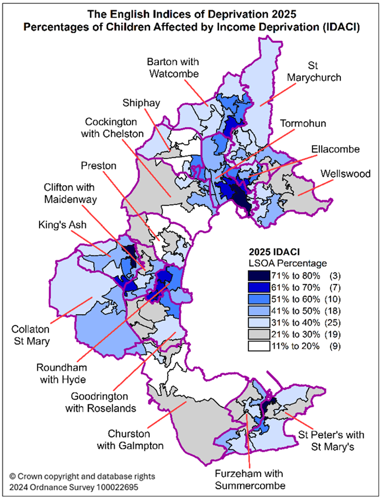
| Area | Approximate IDACI Shading | Meaning |
|---|---|---|
| Tormohun | Very dark blue | 71%–80% (highest deprivation) |
| Ellacombe | Very dark blue | 71%–80% |
| King’s Ash | Very dark blue | 71%–80% |
| Roundham with Hyde | Very dark blue | 71%–80% |
| Furzeham with Summercombe | Very dark blue | 71%–80% |
| Clifton with Maidenway (central parts) | Dark or very dark blue | 61%–80% |
| Preston (central parts) | Medium–dark blue | 51%–70% |
| Cockington with Chelston | Medium blue | 51%–60% |
| Barton with Watcombe | Light–medium blue | 41%–60% |
| St Marychurch | Light–medium blue | 41%–60% |
| Shiphay | Light blue | 41%–50% |
| Preston (outer areas) | Light blue | 41%–50% |
| Clifton with Maidenway (outer areas) | Light blue | 41%–50% |
| Collaton St Mary | Pale blue–grey | 21%–30% |
| Goodrington with Roselands | Pale blue–grey | 21%–30% |
| Churston with Galmpton | Pale blue–grey | 21%–30% |
| St Peter’s with St Mary’s | Pale blue–grey | 21%–30% |
| Wellswood | Light grey | 11%–20% (lowest deprivation) |
Educational and developmental needs are a significant part of Torbay’s local context, with around three in every hundred children having Special Educational Needs and high numbers of referrals into children’s social care, reflecting the complex and varied challenges many families experience. For some, family life in Torbay is also shaped by further challenges. High levels of mental health need, homelessness and economic vulnerability affect household stability and can impact children’s early experiences and outcomes. Furthermore, some early health concerns appear very young; more than a quarter of five‑year‑olds have visible dental decay and almost a quarter of children aged four to five are already overweight or obese. These early challenges can shape a child’s development and future health.
Existing services
Following the receipt of Family Hubs and Start for Life funding in 2022, a broad and diverse network of services that support children and families across the early years has been developed and implemented. These services span home learning, parenting, early education and childcare (ECEC), health, community engagement, and early help. They are delivered collaboratively by Torbay Local Authority, Torbay and South Devon NHS Foundation Trust (TSDFT), Action for Children and early years settings. The diagram below maps the current support and activities against the locally adapted Every Child Matters outcome framework, covering Safe, Happy, Healthy, Learning and Community domains. Figure three: Torbay early childhood development support and activities mapped to the Every Child Matters framework.
Safe
- Families first
- Family support
- Restorative parenting
- Family group conference
- Cost of living/housing surgeries
- Emotional stability and early help for families
Happy
- Emotional wellbeing
- Newborn baby observations
- Video interaction guidance
- Building babies brains
- Parent -infant relationship
- Solihull online and face-to-face
- Wellbeing guidance
- Wellbeing groups
- Therapy (IAPT)
Healthy
- Breastfeeding masterclass
- Antenatal classes
- Feed and nurture
- Infant feeding clinic/drop-ins
- Peer support
- No rush to mush
- Supporting a solid start
- Dental packs
- Smoking cessation
- Immunisations
- Allergies/choking advice
- Food vouchers
- Healthy start vouchers
Learning
- Peep
- Early talk boost
- Chat, play,read
- ASQ - 3/ELIM
- Thriving child
- Discover sessions
- Bounce and ryme
- Bookstart packs
- Portage home visits
- Early language home visits
- Talk and play
Community
- Toddler groups
- Faith groups
- Foodbanks
- Parent carer panels
- Home-start
- Pandas
- Community connections
- Parent connections
Summary of key strengths
Torbay’s early years system has developed into a collaborative and well‑integrated partnership, with strong alignment between the Local Authority, Public Health Nursing, Torbay and South Devon NHS Foundation Trust (TSDFT), Early Years providers and the voluntary and community sector. This joined up approach is one of the system’s most prominent strengths, creating a coherent offer for families from pregnancy to age five and ensuring children receive timely, coordinated support rather than isolated interventions. Key contributions to this include:
- The Family Hubs model, which has been central to this transformation. Co‑location of services, consistent pathways and shared values have created a system that families experience as supportive, relational and accessible.
- A high‑quality Early Years sector, with 98% of inspected providers rated Good or Outstanding and consistently high take up of funded entitlements, meaning most children access high‑quality provision early in life.
- Strong health visiting coverage, with 98.6% of children receiving their ASQ3 assessment, enabling almost universal early identification of need.
- Growing capability in data interpretation and use, allowing partners to better understand children’s development and target support more effectively.
- Improved data sharing across partners, supported by pathways such as the Early Years Development Pathway, which align assessment information to strengthen early identification and reduce duplication.
- A wide range of evidence‑based interventions, including PEEP, Solihull, Early Talk Boost, Incredible Years, Triple P and Video Interaction Guidance (VIG), all contributing to improvements in communication, early relationships and parental confidence.
- Strong Perinatal Infant Mental Health and infant feeding support, with breastfeeding rates rising to 58% at 6–8 weeks and Public Health Nursing achieving UNICEF Baby Friendly Initiative (BFI) Gold accreditation.
Summary of key gaps
Despite strong foundations, Torbay continues to face several systemwide gaps that limit progress in early child development and constrain the pace at which inequalities can be reduced. While services are increasingly coordinated, outcomes show that some groups of children are still not benefiting fully from the local offer, and areas of inconsistency across practice, pathways and engagement exist. These gaps highlight the need for greater reach, stronger alignment and more targeted use of evidence‑based approaches. Key challenges include:
- Persistent inequalities in early child development, with disadvantaged children, those eligible for FSM, children with English as an Additional Language, boys and summer born children achieving lower outcomes across the Early Learning Goals (ELGs) that contribute to GLD.
- Underperformance in key developmental areas, particularly fine motor skills, early maths, self‑regulation, listening and attention, and managing self, all of which significantly influence whether children achieve a GLD.
- Inconsistent engagement from priority families, including young parents and families with EAL, who are not routinely accessing HLE, parenting or Healthy Babies interventions despite being most likely to benefit.
- Limited capacity to deliver evidence‑based interventions at scale, affecting reach and reducing the system’s ability to intervene early and consistently for children identified as at risk.
- Variation in approaches to school readiness and transitions, with no single standardised transition process or shared understanding of school readiness expectations across settings, schools and professionals.
- SEND pathways that are not uniformly understood, leading to variation in early identification, differing interpretations of Ordinarily Available Provision, and inconsistent referral routes across partners.
- Gaps in data and digital integration, particularly around tracking children’s development between the 2.3 year ASQ review and school entry, and continued reliance on manual data collation across multiple systems.
- Under‑representation of priority cohorts in co‑production and parent voice activity, alongside inconsistent “you said, we did” feedback loops, meaning lived experience is not always fully embedded in service development.
Contact Family Information Service
More in Children and families
- Services and support
- Private fostering
- Peninsula Commissioning and Procurement Partnership
- Celebration Event May 2022
- Our Ways of Working
- Fostering
- Home learning environment and early years
- UNICEF Child Friendly Community
- Participation groups for young people
- Torbay Safeguarding Children Partnership Training
- Corporate Parenting
- Care Experienced local offer
- Corporate Parenting Strategy 2025/28
- Ofsted inspection 2026
- World Social Work Day 2026
- Best Start in Life Plan