Sections
Contents
The future of local Government in Devon
In this section we explain the challenges and opportunities faced by Devon and describe the strengths, weaknesses and financial feasibility of the options for local Government reorganisation which we have considered.
We then set out the outline case for our proposed four unitary solution for the future of local Government in Devon.
Devon – the people and the place
Our ambitions
The County of Devon is a unique place to live and work – where people feel a sense of connection to their environment and their communities.
As a large geographic area, Devon is made up of dispersed populations with three major urban areas – the two cities of Plymouth and Exeter and the conurbation of Torbay (the second largest south west of Bristol).
Two National Parks and two stunning coastlines set the tone for our environment and, as a result, we’re a magnet for tourists. We have good schools across the County and fantastic universities and further education colleges.
Our outstanding environment has shaped the development of our business base with our blue and green infrastructure significantly contributing to the visitor economy. It has also created substantial opportunities in industries such as fishing and agriculture, maritime, defence, and energy. The area is typified by a sense of enterprise, innovation and ambition – with sectors such as advanced manufacturing and engineering, electronics and photonics, and health and pharmaceutical manufacturing having the potential for significant growth.
Across Devon, however, there are major challenges such as an ageing population placing huge pressure on public services, significant pockets of deprivation, skills gaps, low wages, and the migration of young people out of the area - demonstrating a need to create more opportunities for them to stay and thrive.
Collectively, the ambitions which we have for Devon to grow with purpose while sustaining our distinct places are summarised as:
Safe, healthy and thriving communities
We want all residents, including children and young people, to feel and be safe, live well, and thrive in happy, healthy and resilient communities.
Quality homes for all
We want to increase the availability of good quality, affordable and permanent housing that meets local needs, including for vulnerable and care experienced individuals.
Inclusive and sustainable economic growth
We want to create the conditions for a strong, sustainable economy that supports diverse industries, attracts investment and offers good employment and learning opportunities for all.
A connected and prosperous region
We want infrastructure and connectivity that ensures our residents, businesses and visitors can reliably access learning, work and leisure opportunities.
Environmental stewardship
We want to protect and enhance our natural environment, whilst responding to the climate emergency and working towards a net zero carbon future.
Fairness, opportunity and wellbeing
We want to tackle poverty and inequality and support health and wellbeing across all our communities.
As existing unitary authorities, Plymouth City Council and Torbay Council have both demonstrated how services, such as housing, community safety and leisure, can work much more closely with children’s services and adult social care to provide proactive early intervention delivering better outcomes for local people. The subsequent reduction in long-term demand means that services are more effective, efficient and sustainable.
Unitary local government across the whole of Devon will mean that the rest of the population can benefit from these advantages. Reorganisation is an opportunity to reshape services across Devon so that we can deliver our shared ambitions for our communities.
Devon’s population
Situated on the south west peninsula of England, Devon covers an area of 6,709 km² or 2,591 square miles. The 2024 population is 1,254,506 people with 530,181 households (2021 Census).
Key facts about Devon's population2
Largest local authority by population
Plymouth: 272,067
Smallest local authority by population
West Devon: 58,923
Devon's population density against the South West and England
Devon: 187 residents per km2
South West: 247 residents per km2
England: 449 residents per km2
Current population (2024)
1,254,506
Projected population by 2043
1,397,029
Largest population by age
Aged 55 to 59: 89,920
Aged 60 to 64: 88,995
Aged 50 to 54: 79,736
Birth rate decline
22% decline between 2015 (11,635) and 2024 (9,099)
Life expectancy at birth (data for the period 2021 to 2023)
Male: 80,0
Female: 84.0
Highest versus lowest life expectancy by district (data for the period 2021 to 2023)
Male
Lowest: Torbay - 78.3 years
Highest: South Hams - 82.1 years
Female
Lowest: Plymouth – 82.4 years
Highest: South Hams – 85.9 years
Leading causes of mortality for under 75s (data for the period 2019 to 2023)
Cancer: 39%
Cardiovascular disease: 22%
Respiratory disease: 8%
Census predictions from 2022 estimate that Devon’s population will grow to 1,397,029 by 2043, an 11% increase from 2024 population figures. These predictions suggest the older population will increase substantially, particularly in relation to those aged 80 years and over whose numbers are projected to increase by 80%. Conversely, the number of those aged under 20 are projected to fall by 9%.
Migration into Devon from other areas of the UK also remains higher than migration out. It contributed approximately 25,000 people to population growth over the last three years. A further factor in growth will be a requirement for Devon to increase new homebuilding under National Planning Policy Framework reforms. Under the previous methodology Devon was targeted to deliver 6,001 new homes per year. In December 2024, under the revised standard method, targets rose to 7,950 new dwellings and are expected to continue to trend upwards under the model of twice yearly revisions.
In recent years, Devon’s birth rate has declined by 22% from 11,635 births in 2015 to 9,099 in 2024. This means the proportion of people living in Devon in older age groups will rise, with increased likelihood of impacts on health and care services due to increased prevalence of long term health conditions.
Within Devon’s population, people aged 55 to 59 and 60 to 64 years old are the two largest five year cohorts by age. The population profile is significantly different to England with higher proportions in all age groups from 55 to 59 years and older, a much smaller proportion of 25 to 49 year olds and those aged 14 years and younger. Nearly one in four residents are aged 65 and over, with the highest proportion of older people living in East Devon and the least in Exeter.
There is very high demand for children’s services in Plymouth and Torbay. In 2024, there were 121 children looked after per 10,000 children in Torbay and 99 per 10,000 in Plymouth. Demand in the Devon County Council area is lower (59 per 10,000 children) but still towards the upper end of the England average (70 per 10,000). Similarly, across all three upper tier authorities there is high demand for services to support children and young people with Special Educational Needs and/or Disabilities (SEND).
Around 4.2% of people in Devon are from a minority ethnic group that is not white. 1.6% of the population reported their ethnicity as Asian. Around 1.5% of the population reported as mixed ethnicity and 0.5% reported their ethnicity as Black, 0.6% reported their ethnic group as ‘Other’. There is also a lower rate of Gypsy or Irish Travellers at 0.8 per 1,000 residents in Devon compared to England.
Historically, there has been a trend of rising life expectancy at birth for males and females across Devon, mirroring the rest of the country. For example, children born between 2021 and 2023 are expected to live longer than children born between 2001 and 2003. However, data collected over the last decade shows life expectancy has been broadly static during this period across Devon, the South West and England.
Devon as a place to live, learn and work
Devon, including Plymouth and Torbay, benefits from a broad and varied economic geography. Exeter is home to a knowledge led and high value economy; the towns of Torbay combine high value digital technologies with traditional strengths across the visitor economy and healthcare; and Plymouth’s marine and defence economy is central to its economic identity.
The area brings together a range of nationally significant businesses and assets from the Met Office in Exeter to supporting the UK’s Continuous at Sea Deterrent at Devonport in Plymouth. As home to around 30% of the UK’s dairy industry and England’s largest fishing port by value of catch in Brixham, the County is famous as an agricultural and food production hub and is important for the food security of the nation.
We benefit from two world class universities and four nationally significant further education colleges which provide research and training excellence. The area is famous for its broader rural and coastal geography, with much of our population living within the stunning Devon landscape which incorporates the two National Parks of Dartmoor and Exmoor, three UNESCO designations and five National Landscapes.
With a GVA of over £33 billion per annum (2023), Devon offers enormous potential.
It has over 40,000 businesses providing around 500,000 jobs. It is a coherent economic area and has significant sectors with potential for growth, including advanced manufacturing and engineering, environmental technologies, data and clean industries; digital technology; health and pharmaceutical manufacture and wider defence industries, as well as traditional strengths in areas such as tourism and agritech and food production.
But Devon faces challenges which impact on productivity levels as well as the ability for all our residents to have a good quality of life. Rural, urban and the coastal areas of Devon suffer from nationally significant levels of poverty, with parts of Torridge and Northern Devon amongst the bottom 5% worst affected areas of England, and West Devon and Torbay having among the lowest workplace based wages of any authority in the country.
Around 40% of all young people leave the area due to a lack of available housing or to pursue education or employment opportunities. For young people remaining in the area, our ambition for inclusive and sustainable economic growth addresses significant challenges with skills and educational performance. There are pockets of nationally significant educational need and parts of Devon have amongst the lowest Level 4 achievement rates in the country.
Innovative solutions to meet the challenges
Continuous improvement is at the heart of local government with innovative solutions required to achieve the ambition we have for our communities.
As we have appraised options and developed proposals, consideration has been given to the increasing demand for high cost services, the funding of local government and the approach that councils across Devon are taking to these competing challenges.
The funding of local government remains highly uncertain and insufficient to address increasing demand for vital services. The expected review of the funding formula for local government and the reintroduction of multi year settlements is highly awaited. Weighting the formula more towards deprivation means consideration needs to be given to make sure that less deprived areas do not mask the pockets of deep deprivation across Devon.
With early intervention and prevention at the heart of our local services, LGR will bring together services to make sure people can live well and independently within their communities. The Torbay Community Helpline, which acts in combination with statutory services at the front door of adult social care support, shows how successfully co-designing localised solutions can have a positive impact of people’s lives, whilst reducing the demand for statutory services.
Focusing on the localised needs of different areas and using their assets to best advantage provides solutions which provide value for money and can be scaled across the area and the region. Torbay’s innovative Hotels to Homes programme focuses on turning empty hotels into affordable housing for local key workers and those with highest housing need. Alongside creating new affordable housing, Torbay’s Housing Options Team are working to prevent homelessness through joined up working with children’s social care, education and youth services; showing that preventative support can lead to lasting change.
Working with businesses and education settings is critical to inspiring our children and young people, as well as supporting economically inactive residents back into work. Collaborative working and cross referral is key to success. For example, through Build Torbay, the construction sector is developing engaging materials for schools to raise awareness of career opportunities, including the Minecraft challenge for primary pupils and practical solutions for disadvantaged secondary learners as well as initiatives such as Foundations for Work to support the economically inactive. The Sound Futures programme uses creative digital media, music, and radio to inspire and support young people currently not in education, employment or training, helping dozens transition into education including university, training, and employment.
Designing and delivering solutions that focus on prevention, early intervention and innovation is vital and lessons learnt in the existing unitary councils of Plymouth and Torbay will be hugely beneficial. Taken with the changes underway within the NHS this is a time of huge change for our communities. Our focus will always remain on our residents, businesses and communities having the best outcomes.
Options appraisal
In this section we set out our options appraisal for LGR in Devon, assessing the strengths and weaknesses of five credible unitary solutions for Devon. The options we have considered have been developed and tested within Torbay Council and with our partners.
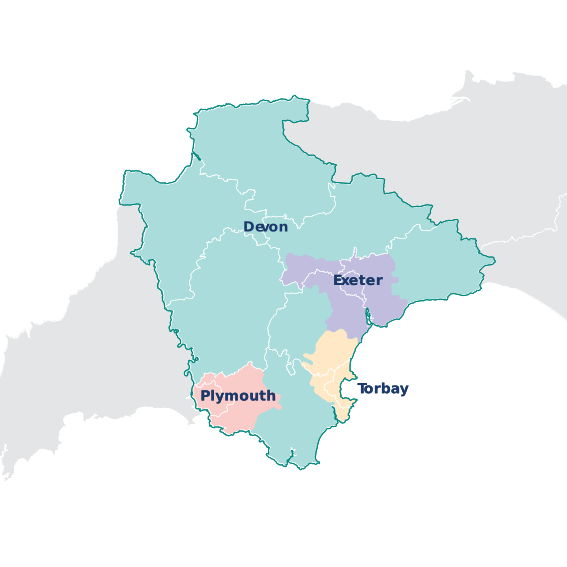
Our recommended option is a four unitary solution for Devon described in Option 3.1:
Torbay Council would continue as a unitary council on its existing boundaries.
Plymouth City Council would continue as a unitary council on expanded boundaries.
A new Exeter Council would be formed to serve an expanded Exeter area.
The creation of a new Rural Devon Coast and Countryside Council.
We conclude this is the best option for Devon to meet the Government’s criteria.
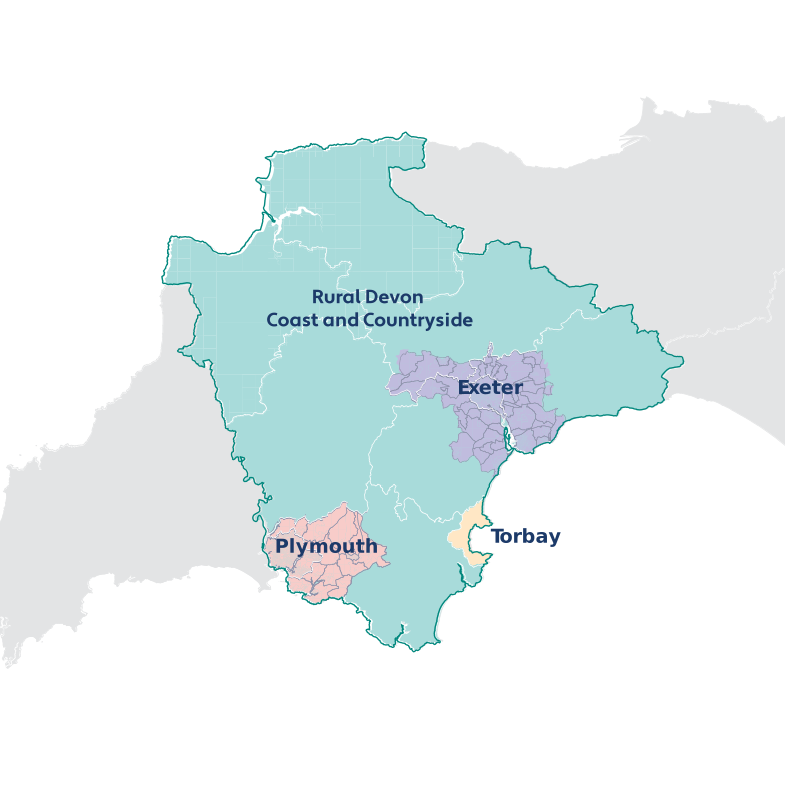
Figure 3. Option 3.1: Torbay Council’s preferred four unitary
solution for single tier local Government in Devon.
The options
Based on the Government’s criteria, subsequent guidance, the dynamics of collaborative working across Devon councils to meet the Government’s robust outcomes, and the current makeup of local Government in Devon, the following options have been appraised.
Option 1: Two unitary councils (Devon and Plymouth)
Plymouth City Council would continue as a unitary council.
The rest of Devon, including Torbay, would be served by a new Devon unitary council.
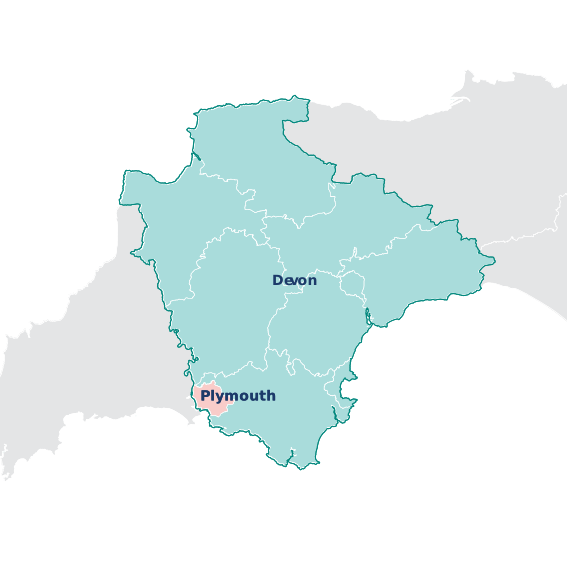
Plymouth UC population: 270,000 (22%)3
Devon UC population: 980,000 (78%)
Option 2.1: Three unitary councils (the 4-5-1 Model)
Plymouth City Council would continue as a unitary council.
The areas of Torbay, South Hams, West Devon and Teignbridge would be served by a new South Devon unitary council.
The areas of Exeter, Torridge, Mid Devon, North Devon and East Devon would be served as by a new North and East Devon unitary council
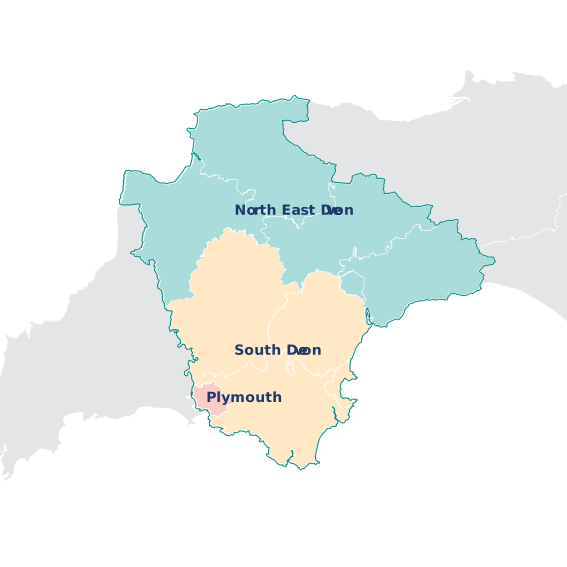
Plymouth UC population: 270,000 (22%)
South Devon UC population: 430,000 (34%)
North East Devon UC population: 550,000 (44%)
Option 2.2: Three unitary councils (Devon, Plymouth and Torbay)
Torbay Council and Plymouth City Council would continue as unitary authorities.
The rest of Devon would be served by a new Devon unitary council.
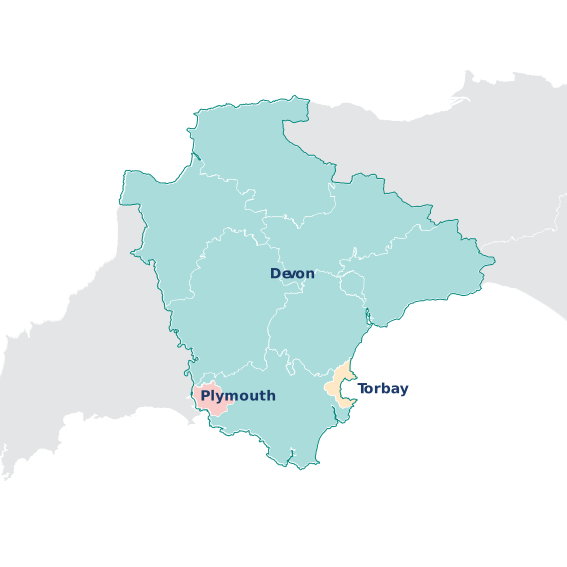
Plymouth UC population: 270,000 (22%)
Torbay UC population: 140,000 (11%)
Devon UC population: 840,000 (67%)
Option 3: Four unitary councils
Option 3.1: Torbay, expanded Plymouth expanded Exeter and Rural Devon Coast and Countryside Councils.
Torbay Council would continue as a unitary council on its existing boundaries.
Plymouth City Council would continue as a unitary council on expanded boundaries.
A new Exeter Council would be formed to serve an expanded Exeter area.
The creation of a new Rural Devon Coast and Countryside Council.
Plymouth UC population: 300,000 (24%)
Torbay UC population: 140,000 (11%)
Exeter UC population: 260,000 (21%)
Devon UC population: 550,000 (43%)
Option 3.2: Expanded Torbay, Plymouth and Exeter Councils and Rural Devon Coast and Countryside Council
Torbay Council and Plymouth City Council would continue as unitary councils on expanded boundaries.
A new Exeter Council would be formed to serve an expanded Exeter area.
The rest of Devon would be served by a new Rural Devon Coast and Countryside Council.
Plymouth UC population: 300,000 (24%)
Torbay UC population: 220,000 (18%)
Exeter UC population: 260,000 (21%)
Devon UC population: 470,000 (37%)
Discounted option
Within our Interim Plan stage, we discounted a single unitary council option.
With a population in excess of 1.25 million people distributed across 6,709 km2, the geographic County of Devon (including Plymouth and Torbay) is the fourth largest by area in England.
In considering LGR options, changes to structures and service delivery arrangements need to achieve the right balance of population size and economies of scale with the practicalities of the geography, culture, society and economy of Devon. Change should also reflect and enhance the communities that have developed under present boundaries whilst optimising efficiencies in service delivery.
Nationally, experience points to the fact that Devon is far too large to enable a single authority to be efficient and effective whilst retaining a sense of place and community.
Therefore, we have continued to discount this option.
Our approach
Principles
The options presented here were reached through extensive engagement and discussion with all of Devon’s councils as well as in discussion with members and senior officers of Torbay Council. From the various configurations of unitary local government in Devon that have been explored, these are the options we believe are the most viable for Devon’s communities.
Alongside the Government’s six LGR criteria and other guidance provided over the last year, we adopted three overarching principles to help guide our approach:
- Any option should be in the best interests of all of Devon’s communities, including maximising the benefits of the existing unitary councils in Devon.
- Options that have the potential to align with the footprints of other public sector partners would be preferred.
- No new council should be set up to fail. Across any new unitary configuration financial resilience and sustainability, service level demand and economic prospects should have relative equity and parity from day one.
Criteria
Each option was then assessed against the Government’s criteria and sub-criteria for LGR which we summarised as:
Criteria 1: Establishing a single tier of local government
Proposals should:
- create a single tier of local government across the area,
- be based on sensible geography and economic viability, and
- be supported by robust evidence and expected outcomes.
Criteria 2: Efficiency, capacity and withstanding financial shocks
New councils should:
- improve efficiency and resilience, and
- be the right size to improve financial stability.
- Proposals should show how transition costs and existing council debt will be managed.
Criteria 3: High quality and sustainable public services
Proposals should show how reorganisation will:
- enhance public service delivery,
- avoid fragmentation, and
- improve outcomes in key areas like social care, children’s services, and public safety.
Criteria 4: Working together to understand and meet local needs
Proposals must show how councils have meaningfully collaborated and engaged. They will:
- reflect community identity
- show how we have addressed public concerns.
Criteria 5: Supporting devolution arrangements
Proposals should:
- enable devolution
- give details of how governance structures will adapt to support strategic authorities.
Criteria 6: Stronger community engagement and neighbourhood empowerment
Building on existing arrangements, proposals will include:
- strong community involvement
- neighbourhood empowerment.
Scoring
We scored each option against each of the six criteria using the following scale:
Low
The option meets very few or none of the criterion’s requirements.
Medium
The option meets some of the requirements of the criterion.
High
The option meets most or all of the requirements of the criterion.
The Government’s criteria is unweighted so no weighting was applied to our scores.
Method
Our appraisal has included a financial and qualitative assessment.
Criterion 1 and 2 have been scored through a financial appraisal based on the indicators set out below:
1. Establishing a single tier of local government
Population
- Projected population growth to 2040
- Council Tax band D average
- Council Tax band D maximum
- Council Tax base
- Council Tax Base per unit of population
- Council Tax income per unit of population
- Business rates per unit of population
2. Efficiency, capacity and withstanding financial shocks
- Grant funding per unit of population
- Non-earmarked reserves
- Non-earmarked reserves per unit of population
- Ratio of financing costs to net revenue
- Total funding/resources 26/7 per head
- Estimated savings from people services (Newton model)4
- Comparative ranking of likely set up costs.
In each financial assessment, we have highlighted areas of particular concern or strengths with a RAG rating and then provided each option with an overall score based on assessment against the Government criteria.
Most assessments have been made by reviewing relevant figures for each potential unitary council and considering the range and imbalance between them. The evaluation of transition costs was based on Torbay Council’s Chief Financial Officer’s assessment of likely transition costs considering the scale of the change that would be required to set up each council within each option.
In conjunction with the financial appraisal, qualitative evaluations were completed iteratively in workshops and engagement sessions held with members and our Senior Leadership Team. In these sessions consideration was given to insights emerging from residents and stakeholder engagement and geographic, demographic and service level data.
Options summary scores
The table below presents the summary scores of the options appraisal supporting our preferred option of a four unitary solution (option 3.1) with Torbay Council continuing on its existing boundaries, the continuing council of Plymouth City Council on expanded boundaries, and the new Exeter and Rural Devon Coast and Countryside unitary councils on their proposed boundaries.
In the remainder of this section, we present the data and insights behind these scores.
| Government criteria | Two unitary councils - Option 1: Plymouth and Devon | Three unitary councils - Option 2.1: Plymouth, South Devon and North East Devon (5-4-1 model) | Three unitary councils - Option 2.2: Torbay, Plymouth and Devon | Four unitary councils - Option 3.1: Torbay, Expanded Plymouth, Exeter and Devon | Four unitary councils - Option 3.2: Expanded Torbay and Plymouth, Exeter and Devon |
|---|---|---|---|---|---|
| 1. Single tier local Government | Low | Medium | Low | High | High |
| 2. Efficiency and capacity | Low | High | Medium | High | High |
| 3. High quality public services | Low | High | High | High | High |
| 4. Understanding local needs | Low | Medium | Medium | High | High |
| 5. Supporting devolution | Low | High | Medium | High | High |
| 6 .Community empowerment | Low | Medium | Medium | High | Medium |
Score: low
| Metric | Devon | Plymouth | Range |
|---|---|---|---|
| Population | 982,439 | 272,067 | not applicable |
| Projected population growth to 2040 | 113% | 104% | not applicable |
| Council Tax band D average | 2,398 | 2,325 | not applicable |
| Council Tax band D maximum | 2,471 | 2,325 | not applicable |
| Council Tax base | 368,699 | 76,557 | not applicable |
| Council Tax Base per unit of population | 2.66 | 3.55 | 0.89 |
| Council Tax income per unit of population | 770 | 580 | -190 |
| Business rates per unit of population | 203 | 245 | 42 |
Financial assessment
Strengths
The model shows a good balance across unitaries for some of the metrics around council tax and business rates with lower variances for the rates per head of population.
Weaknesses
There is imbalance across unitaries when looking at population and tax base sizes and concerns about the overall size of the Devon unitary.
Qualitative appraisal
Strengths
Provides more land for economic growth and housing within the new Devon unitary council.
Any potential expansion of Plymouth City Council is based on the Plymouth Growth Area and aligns well with its distinct Travel to Work Area.
Weaknesses
Without an expansion of Plymouth City Council’s boundary, the natural growth potential for Plymouth City Council would be limited.
There could be competing resource allocation priorities between the coastal, rural and urban areas of a new Devon unitary council.
Extreme imbalance in geographic size (Plymouth at 80 km2 and Devon at 6,627 km2) with the new Devon unitary council being much larger than housing market and travel to work areas.
The very large population of a new Devon unitary council (approx. 1 million people) could obscure distinct needs, in particular combining Torbay’s urban deprivation with the rural service frailty of the rest of Devon.
The geographic scale of a new Devon unitary council creates risks with a lack of connectivity across the area, and risks diluting visibility of Torbay’s distinct high-demand/low-cost profile for services.
2. Efficiency, capacity and withstanding financial shocks
Score: low
| Metric | Devon | Plymouth | Range |
|---|---|---|---|
| Grant funding per unit of population | £305 | £452 | 146 |
| Non-earmarked reserves | £27,960,000 | £-60,138,000 | -88,098,000 |
| Non-earmarked reserves per unit of population | £28 | £-221 | -249.50 |
| Ratio of financing costs to net revenue | 5% | 8% | 3% |
| Total funding/resources 26/7 per head | £1,530.53 | £1,260.82 | 269.71 |
| Comparative ranking of likely set up costs | neutral | positive | neutral |
Estimated savings from people services
Devon and Plymouth: £43.67m
Financial assessment
Strengths
The Newton model suggests a high level of potential savings is possible. The option provides the best balance of financing costs to net revenue budget.
Weaknesses
It shows the largest imbalance in reserves and funding per head, placing continuing challenges on the viability of Plymouth, without any expansion. Transition costs are expected to be reasonably high due to changes across Devon and to Torbay as an existing unitary, but helped by no change in Plymouth.
Qualitative appraisal
Strengths
Could deliver economies of scale and financial efficiencies in service delivery across a large area and through a significant reduction in administrative duplication and cost.
Weaknesses
The populations of the two authorities would not be equal, with the size of the new Devon unitary council well above the Government’s guiding principle of a population of 500,000 or more.
The new Devon unitary council may be too large and lose some of the efficiencies available from more local working.
There could be false economies, with costs within the new Devon unitary council likely to harmonise upwards towards Devon averages, eroding Torbay’s lower long term care costs.
Fragile local care markets in Torbay and South Devon could be obscured, with centralised commissioning frameworks likely to inflate costs and reduce responsiveness.
The creation of a new Devon unitary council could blur financial clarity by merging areas with very different income and deprivation profiles and financial challenges.
Theoretical financial sustainability and resilience, but experience from elsewhere, for example Somerset Council and Birmingham City Council, shows that larger councils are not as efficient as smaller authorities.
3. High quality public services
Score: low
Strengths
Existing Devon children’s services and adult social care would not need to be disaggregated enabling a focus on improving children’s services and services for children and young people with SEND.
Opportunity to help shape the market for children’s services and adult social care in a wider geography.
Weaknesses
Increased difficulties in trying to manage and improve complex systems such as children’s services and adult social care across a large geography, with a “one size fits all” approach failing to address divergent challenges, with increased costs indicated.
Children’s services and adult social care within Torbay would need to be aggregated into the new Devon unitary council with the risk that current Good services are negatively impacted.
Whilst administratively simpler, the creation of new Devon unitary council risks masking Torbay’s improvements and compounding Devon’s current financial and performance led challenges, blurring distinct profiles into averages (especially in relation to children’s services, adult social care and SEND).
The creation of a new Devon unitary council could weaken the strategic focus on deprivation and increase the risk of under resourcing high need urban populations. Difficult to undertake effective coproduction across a bigger geographic area, making it more challenging to have really good service design.
Extreme differences in population density (Plymouth: 3,366 people/km2, verses Greater Devon: 147 people/km2 may lead to service delivery challenges).
The creation of a Devon unitary council would likely result in the end of the groundbreaking Integrated Care Organisation which currently delivers joined up health and social care to the residents of Torbay, including the community support model which supports residents without the need for statutory services.
The impact of combining authorities with and without Housing Revenue Accounts into a new Devon unitary council would need to be considered carefully.
4. Understanding local needs
Score: low
Strengths
A new Devon unitary council would blend urban, rural and coastal communities which could reflect the pan-Devon sense of belonging.
A new Devon unitary council would closely mirror the footprint of many county level public services (such as Devon and Cornwall Police, Devon and Somerset Fire and Rescue Service and NHS Devon Integrated Care Board).
Plymouth retains its strong urban identity.
Plymouth’s standalone status aligns with existing arrangements in health and policing, as well as its distinct Travel to Work Area.
Weaknesses
Combining Torbay (with its existing unitary council) with rural districts may create tensions in prioritisation.
A large unitary council would average out local need, reducing alignment between service models and community demand, and risks weaker integration with health and community safety.
A new Devon unitary council does not fit well with people’s local sense of identity and their connection to their local town and community.
Devon wide unitary includes multiple travel to work areas, which may dilute alignment with specific commuting patterns.
There would be a loss, or dilution, of local tourism identities including the English Riviera, Jurassic Coast, North Devon’s Adventure Coast and Dartmoor.
Difficult to have a strong, coherent Voluntary, Community and Social Enterprise sector (VCSE) across a large geography, which is vital for supporting preventative work within communities.
5. Supporting devolution
Score: low
Strengths
There is the potential for a two unitary solution to enable a Strategic Authority across the County footprint.
Weaknesses
The Devon and Torbay Combined County Authority would cease to exist.
The new Devon unitary council would need to articulate the exceptional circumstances by which the Secretary of State would use their power to designate the Council as a Foundation Strategic Authority.
If the new Devon unitary council is designated a Foundation Strategic Authority, it will not have access to the full range of devolved powers and funding as a Mayoral Strategic Authority (MSA).
If Plymouth City Council’s boundaries are extended, there would be democratic disenfranchisement for those parts of the current South Hams District Council which would no longer be covered by the devolved powers the Foundation Strategic Authority.
Alternatively, the new Devon unitary council and Plymouth City Council could work together to create a Strategic Authority, however there would be an unequal population size ratio between the two authorities.
The difference in size between the two unitaries could raise concern about equity of representation and strategic influence within any future Strategic Authority.
In this scenario, if Plymouth City Council did not wish to work with the new Devon unitary council to create a Combined Authority, Plymouth City Council would become a “devolution island”.
6. Community empowerment
Score: low
Strengths
Potential for greater financial capacity to invest in community engagement.
Neighbourhood committees would be essential within the new Devon unitary council, but may lack proximity to communities.
Plymouth City Council has existing voluntary and community sector partnerships, but would need neighbourhood forums to represent local voice.
Weaknesses
Potential for democratic deficit in the new Devon unitary council due to large geographic spread, with the potential of struggling to maintain meaningful local engagement due to scale.
Communities in Exeter, Paignton and Torquay are not currently served by parish councils which could lead to disparity of representation and services across a new Devon unitary council.
More difficult for communities to have access to their local councillors and the democratic process in a new Devon unitary council due to poor connectivity in a large geographic area.
The new Devon unitary council would be further away from communities and would need to mitigate this through effective neighbourhood governance.
Complexity and scale risk weakening neighbourhood empowerment and accountability.
Option 2.1: Three unitary councils
(The 4-5-1 model)
1. Establishing a single tier of local government
Score: medium
| Metric | Plymouth | South Devon | North East Devon | Range |
|---|---|---|---|---|
| Population | 270,000 | 430,000 | 550,000 | not applicable |
| Projected population growth to 2040 | 104% | 111% | 115% | not applicable |
| Council Tax band D average | £2,359 | £2,400 | £2,396 | not applicable |
| Council Tax band D maximum | £2,392 | £2,471 | £2,433 | not applicable |
| Council Tax base | 82,499 | 162,440 | 200,317 | not applicable |
| Council Tax base per unit of population | 3.30 | 2.65 | 2.76 | 0.65 |
| Council Tax income per unit of population | £599 | £822 | £772 | 223 |
| Business rates per unit of population | £243 | £218 | £191 | 52 |
Financial assessment
Strengths
The model provides the least disparity around population which helps to provide a good balance across the unitaries for some of the metrics around council tax and business rates with lower variances for the rates per head of population.
Weaknesses
Estimates of 2040 population suggests the very low growth rate for Plymouth continues, despite a small expansion – suggestive of financial challenges due to low council tax base. This also presents itself in the low council tax income per head for Plymouth and large imbalances across the unitaries.
Qualitative appraisal
Strengths
Provides more land for economic growth and housing within the two new unitary councils. The areas covered by the new North East Devon unitary council already look to Exeter as a centre, especially as a centre for commerce.
Creates an urban/rural balance with Plymouth preserved as an urban centre and the two new unitary councils relatively balanced as urban/rural/coastal areas.
Retains clearer local responsiveness and accountability.
Provides coherence with the new South Devon unitary council sharing demographic pressures (including frailty and statutory reliance), and the new North East Devon unitary council providing scale.
Provides resilience through scale whilst keeping local profiles visible.
Weaknesses
Within the new South Devon unitary council, there is no centre of commerce or economic activity at the scale of the Devon’s cities with no current consensus on the primary or principal centre of commerce.
On existing Plymouth City Council boundaries, there is a significant difference in geographic size (Plymouth: 80 km2, North East Devon unitary council: 3,844 km2, South Devon unitary council: 2,783 km2).
If Plymouth City Council’s boundaries where expanded, this would have a negative impact on the growth potential for the new South Devon unitary council.
If Plymouth City Council’s boundaries are not expanded, it limits that Council’s ability to grow.
2. Efficiency, capacity and withstanding financial shocks
Score: high
| Metric | Plymouth | South Devon | North East Devon | Range |
|---|---|---|---|---|
| Grant funding per unit of population | £439 | £325 | £294 | 114 |
| Non-earmarked reserves | £-59,844,305 | £12,617,305 | £15,049,000 | £-74,893,305 |
| Non-earmarked reserves per unit of population | £-220 | £29 | £27 | -249.32 |
| Ratio of financing costs to net revenue | 8% | 5% | 5% | 3% |
| Total funding/resources 26/7 per head | £1,242.54 | £1,320.86 | £1,401.11 | 158.57 |
| Comparative ranking of likely set up costs | positive | neutral | neutral | neutral |
Estimated savings from people services
Plymouth, South Devon and North-East Devon: £32.93m
Financial assessment
Strengths
The model shows a good balance across the unitaries with a smaller range for criteria such as grant funding and overall resources per head of population. Estimated people services savings are reasonable although not as high as other models.
Weaknesses
Transition costs are estimated to be relatively high due to changes across all Councils including Torbay as an existing unitary authority.
Although savings estimated remain at a reasonable level they are the lowest out of all the options. Plymouth financial challenges not improved.
Qualitative appraisal
Strengths
The population numbers of the proposed new unitary councils, together with the population of Plymouth, are close to the guiding principle of councils having a population of 500,000 or more.
Smaller organisations based in smaller geographies help to support local innovation.
Balances local responsiveness with some economies of scale, with the most opportunities for ongoing service budget savings.
Whilst there will be some upwards harmonisation of costs, these present significantly less risk than Option 1 and are contained in the sub-region.
Weaknesses
The demography of the new South Devon unitary council has an older, and ageing, population base which could lead to increased demand for adult social care and the associated costs.
3. High quality public services
Score: high
Strengths
Opportunity to help shape the market for children’s services and adult social care in a wider geography.
Allows targeted approaches to different levels of income deprivation (Plymouth: 24.4%, North East Devon unitary council: 17.3%, South Devon unitary council: 19.6%)
Allows for regional variation to be visible while pooling resilience across sub-regions, including opportunities for regional commissioning.
The new North East Devon unitary council would have a stronger, sustainable base within the adult social care market, with the market in South Devon more fragile, although a local focus would help tackle accessibility issues.
Creates a balanced footprint across the existing Devon and Torbay areas which enables the improvement of children in care sufficiency.
Weaknesses
Services over a larger geography would have to be carefully and sensitively created, otherwise they would not be relatable to place.
Both new unitary councils would need to develop delivery models which serve both rural and urban areas.
There would be challenges in disaggregating children’s services and adult social care into the new South Devon and North East Devon unitary councils, with the added challenge of also aggregating the existing children’s services and adult social care of Torbay Council into the South Devon unitary council.
The creation of a South Devon unitary council would likely see the end of the groundbreaking Integrated Care Organisation which currently delivers completely joined up health and social care to the residents of Torbay, including the community support model which supports residents without the need for statutory services.
The impact of combining authorities with and without Housing Revenue Accounts into a new North East Devon unitary council would need to be considered carefully.
4. Understanding local needs
Score: medium
Strengths
New North East Devon unitary council comprises, North Devon and Torridge with a shared coastal/rural identity, Mid Devon which bridges rural and urban; East Devon which connects Exeter.
New South Devon unitary council contains Dartmoor and coastal synergy with a diverse economy in marine, tourism, agriculture, and digital innovation.
North East Devon and South Devon unitaries reflect some existing service groupings, but Exeter’s inclusion in the North East Devon Council may complicate alignment with NHS and police zones.
The North East Devon unitary aligns well with Exeter Travel to Work Area and rural commuting flows.
South Devon unitary reflects Plymouth and Torbay Travel to Work Areas and their economic hinterlands.
Plymouth’s standalone status aligns with existing arrangements in health and policing and aligns well with its distinct Travel to Work Area.
Protects the distinct trajectories of each area, including Torbay’s Children’s Services improvements, Plymouth’s urban safeguarding pressures and the rural dementia and adult social care challenges in Devon.
Weaknesses
The new South Devon and North East Devon unitaries are larger than how people see their communities.
5. Supporting devolution
Score: high
Strengths
It would be relatively straightforward for the existing Devon and Torbay Combined County Authority (DTCCA) to be transferred into a Devon Combined Authority with the new North East Devon and South Devon unitary councils being constituent members (if Plymouth City Council remains on its existing boundaries).
All existing Leaders of the Devon councils are in favour of pursuing a MSA for the whole of Devon. This option would enable such an Authority on a whole county footprint, including Plymouth City Council.
There would be equality of population size ratios between constituent authorities of any new MSA.
Weaknesses
If Plymouth City Council’s boundaries are extended, there would be democratic disenfranchisement from the Combined Authority for those parts of the current South Hams District Council which would no longer be covered by the devolved powers of the Combined Authority.
If the Devon Combined Authority wishes to remain as a Foundation Strategic Authority and Plymouth City Council does not wish to join (as per the option with the DTCCA’s Constitution), Plymouth City Council would become a “devolution island”.
6. Community empowerment
Score: medium
Strengths
Strong parish networks in North East Devon and South Devon unitaries could support area committees.
Potential for greater financial capacity to invest in community engagement.
Existing voluntary and community sector partnerships in Torbay and South Hams can be built upon.
Plymouth City Council has existing voluntary and community sector partnerships, but would need neighbourhood forums to represent local voice.
Enables some scale for investment and innovation whilst retaining local responsiveness.
Weaknesses
Communities in Exeter, Paignton and Torquay are not currently served by parish councils which could lead to disparity of representation and services in both the new South Devon and North East Devon unitary councils.
Option 2.2: Three unitary councils
(Devon, Plymouth and Torbay)
1. Establishing a single tier of local government
Score: low
| Metric | Plymouth | Torbay | Devon | Range |
|---|---|---|---|---|
| Population | 270,000 | 140,000 | 840,000 | not applicable |
| Projected population growth to 2040 | 104% | 106% | 114% | not applicable |
| Council Tax band D average | £2,325 | £2,340 | £2,405 | not applicable |
| Council Tax band D maximum | £2,325 | £2,340 | £2,471 | not applicable |
| Council Tax base | 76,557 | 49,254 | 319,445 | not applicable |
| Council Tax base per unit of population | 3.55 | 2.83 | 2.64 | 0.92 |
| Council Tax income per unit of population | £580 | £726 | £808 | -229 |
| Business rates per unit of population | £245 | £261 | £193 | 69 |
Financial assessment
Strengths
Limited but includes a more unified voice to central Government.
Weaknesses
The model does not show a good balance across unitaries for some metrics around council tax and business rates with high variances for the rates per head of population. There is imbalance across unitaries when looking at population and tax base sizes and concerns about the overall size of the Devon unitary. Estimates of 2040 population also suggests imbalance and a very low growth rate for Plymouth, suggesting financial challenges due to low council tax base.
Qualitative appraisal
Strengths
Retains clearer local responsiveness and accountability. Reflects the distinct socio-economic, demographic, and service delivery realities across Torbay, Plymouth, and the rest of the Devon County area.
The potential expansion of Plymouth City Council is based on the Plymouth Growth Area and aligns well with its distinct Travel to Work Area.
Weaknesses
Extreme imbalance in geographic size (Torbay at 63km2, Plymouth at 80km2 and Devon at 6,627km2) with the new Devon unitary council being much larger than housing market and travel to work areas.
The geographic scale of a new Devon unitary council creates risks with a lack of connectivity across the area.
2. Efficiency, capacity and withstanding financial shocks
Score: medium
| Metric | Plymouth | Torbay | Devon | Range |
|---|---|---|---|---|
| Grant funding per unit of population | £452 | £514 | £270 | 244 |
| Non-earmarked reserves | £-60,138,000 | £6,400,000 | £21,560,000 | -81,698,000 |
| Non-earmarked reserves per unit of population | £-221 | £46 | £26 | -246.64 |
| Ratio of financing costs to net revenue | 8% | 9% | 4% | 5% |
| Total funding/resources 26/7 per head | £1,260.82 | £1,501.36 | £1,277.76 | 240.54 |
| Comparative ranking of likely set up costs | positive | positive | neutral | positive |
Estimated savings from people services
Plymouth, Torbay and Devon: £42,16m
Financial Assessment
Strengths
The Newton model suggests a high level of potential savings is possible. Transition costs are expected to be relatively low as both Plymouth and Torbay would continue unchanged as existing unitaries.
Weaknesses
It shows a large imbalance in reserves and funding per head, placing continuing challenges on the viability of Plymouth, without any expansion. It also presents a large variance and imbalance in the rate of grant funding per head.
Qualitative appraisal
Strengths
Protects Torbay Council’s lower long term care costs from a potential significant uplift if merged into a Devon unitary council.
Avoids potential cost uplifts in Torbay and Plymouth from harmonisation.
More transparent financial planning and accountability, allowing resources to be aligned to differing socio economic needs.
Preserves visibility of very different financial profiles in relation to children’s services enabling tailored local strategies.
Weaknesses
The populations of the authorities would not be equitable, with the size of the new Devon unitary authority well above the Government’s guiding principle of a population of 500,000 or more.
3. High quality public services
Score: high
Strengths
Maintains the groundbreaking Integrated Care Organisation which currently delivers joined up health and social care to the residents of Torbay, including the community support model which supports residents without the need for statutory services.
Reflects the distinct profiles of the three areas in relation to high cost services, enabling local support dependant on need.
All three areas face age related pressures but with Plymouth and Torbay on sharper trajectories; this option enables localised support dependant on need.
Supports a more tailored service model responsive to urban versus rural contexts.
Children’s services and adult social care would not need to be disaggregated in Plymouth or Torbay enabling a focus on improving children’s services and services for children and young people with SEND.
Preserves accountability for local performance variations, especially in relation to children’s services, enabling tailored improvement.
Preserves visibility of very different demand, practice and cost profiles across the three upper tier authorities.
Preserves visibility of different SEN profiles, enabling the adoption of tailored improvement strategies.
Enables joint commissioning where appropriate, including for market shaping, but preserves clear local accountability for managing costs.
Enables local solutions to be found for different workforce pressures and retains local responsiveness to these pressures.
Weaknesses
Services over a larger geography within the new Devon unitary council would have to be carefully and sensitively created, otherwise they would not be relatable to place.
Difficult to undertake effective coproduction across a bigger geographic area, making it more difficult to have really good service design.
The impact of combining authorities with and without Housing Revenue Accounts into a new Devon unitary council would need to be considered carefully.
4. Understanding local needs
Score: medium
Strengths
Supports local councils’ abilities to meet the distinctive needs of their communities better.
New Devon unitary council blends urban, rural and coastal communities which could reflect the pan-Devon sense of belonging.
Plymouth and Torbay retains their strong urban identity, including the identities of Britain’s Ocean City and the English Riviera.
Plymouth and Torbay’s standalone status aligns with existing arrangements in health and policing, and reflects Plymouth’s distinct Travel to Work Area.
Maintains the strong, coherent voluntary, community and social enterprise sectors within Plymouth and Torbay, vital for supporting preventative work within communities.
Protects the distinct trajectories of each area, including Torbay’s Children’s Services improvements, Plymouth’s urban safeguarding pressures and the rural dementia and adult social care challenges in Devon.
Weaknesses
A new Devon unitary council does not fit well with people’s local sense of identity and their connection to their local town and community.
Devon wide unitary includes multiple Travel to Work Areas, which may dilute alignment with specific commuting patterns.
5. Supporting devolution
Score: medium
Strengths
It would be relatively straightforward for the existing Devon and Torbay Combined County Authority to be transferred into a Devon Combined Authority with the new Devon unitary council and Torbay Council being constituent members.
All existing Leaders of the Devon Councils are in favour of pursuing a MSA for the whole of Devon. This option would enable such an Authority on a whole county footprint, including Plymouth City Council.
Weaknesses
There would be inequality of population size ratios between constituent authorities of any new MSA.
If Plymouth City Council’s boundaries are extended, there would be democratic disenfranchisement from the Combined Authority for those parts of the current South Hams District Council which would no longer be covered by the devolved powers the Combined Authority.
If the Devon Combined Authority wishes to remain as a Foundation Strategic Authority and Plymouth City Council does not wish to join (as per the option with the DTCCA’s Constitution), Plymouth City Council would become a “devolution island”.
6. Community empowerment
Score: medium
Strengths
Torbay Council has an existing network of Community Partnerships which could form the basis of neighbourhood committees.
Plymouth City Council has existing voluntary and community sector partnerships, but would need neighbourhood forums to represent local voice.
Communities in Plymouth and Torbay would maintain closer access to local councillors and the democratic process.
Compact unitaries sustain local voice and alignment with residents’ needs.
Weaknesses
Potential for democratic deficit in the new Devon unitary council due to large geographic spread, with the potential of struggling to maintain meaningful local engagement due to scale.
More difficult for communities to have access to their local councillors and the democratic process in a new Devon unitary council due to poor connectivity in a large geographic area.
The new Devon unitary council would be further away from communities and would need to mitigate this through effective neighbourhood governance.
Complexity and scale within the new Devon unitary council risk weakening neighbourhood empowerment and accountability.
The following two variations of option 3 (3.1 for Torbay to remain within its current boundaries and 3.2 for Torbay to expand its boundaries) share much of a common rationale. They scored very similarly, only differing on criterion six - Community Empowerment. Therefore, the tables below present much of the same information. We have presented them here separately for ease of reference and to highlight the distinctive aspects of their financial evaluation.
Option 3.1: Four unitary councils (Torbay, expanded Plymouth and new Exeter and Rural Devon Coast and Countryside Councils)
1. Establishing a single tier of local government
Score: high
| Metric | Plymouth | Torbay | Exeter | Devon | Range |
|---|---|---|---|---|---|
| Population | 300,000 | 140,000 | 260,000 | 550,000 | n/a |
| Projected population growth to 2040 | 105% | 106% | 114% | 115% | n/a |
| Council Tax band D average | £2,359 | £2,340 | £2,394 | £2,405 | n/a |
| Council Tax band D maximum | £2,392 | £2,340 | £2,433 | £2,433 | n/a |
| Council Tax base | 92,984 | 49,254 | 90,266 | 212,752 | n/a |
| Council Tax base per unit of population | 3.23 | 2.83 | 2.84 | 2.52 | 0.71 |
| Council Tax income per unit of population | £630 | £726 | £720 | £837 | -207 |
| Business rates per unit of population | £238 | £261 | £178 | £201 | 60 |
Financial assessment
Strengths
This model has a good balance across the four unitaries and provides the best balance in the council tax base per head of population and good balance across the council tax income and business rates per head of population. With an expanded Plymouth the council tax base issues are improved with estimated growth figures.
Weaknesses
Limited. Separation of the three major urban centres may result in some economic challenges for a rural Devon, although council tax base and rates per head of population appear reasonable.
Qualitative appraisal
Strengths
Retains clearer local responsiveness and accountability.
Reflects the distinct socio-economic, demographic, and service delivery realities across Torbay, Plymouth, Exeter and the rest of Devon.
Bases three unitary councils around the urban areas of Exeter, Plymouth and Torbay with dense populations and clear identities, and being service centres for the surrounding rural and coastal communities. The fourth unitary council has a clear rural focus.
Weaknesses
The geographic scale and fragmentation of a new Devon unitary council creates risks with a lack of connectivity across the area.
2. Efficiency, capacity and withstanding financial shocks
Score: high
| Metric | Plymouth | Torbay | Exeter | Devon | Range |
|---|---|---|---|---|---|
| Grant funding per unit of population | £419 | £514 | £309 | £259 | 255 |
| Non-earmarked reserves | £-59,326,065 | £6,400,000 | £9,159,316 | £11,588,748 | -71,433,053 |
| Non-earmarked reserves per unit of population | £-97 | £46 | £36 | £22 | -243.18 |
| Ratio of financing costs to net revenue | 7% | 9% | 6% | 4% | 5% |
| Total funding/resources 26/7 per head | £1,242.54 | £1,501.36 | £1,314.72 | £1,271.28 | 258.82 |
| Comparative ranking of likely set up costs | positive | positive | negative | neutral | positive |
Estimated savings from people services
Plymouth, Torbay, Exeter and Devon: £38.17m
Financial assessment
Strengths
The Newton model suggests a high level of potential savings is possible. Transition costs are expected to be relatively low due to the two current Unitary Councils continuing - Torbay would remain unchanged and Plymouth with a slight expansion.
Weaknesses
The imbalance between the level of funding per head of population is high with Torbay remaining unchanged and could continue. Although Plymouth expands it still has some financial challenges with the lowest rate of funding per head and low reserves per head.
Qualitative appraisal
Strengths
Protects Torbay Council’s lower long term care costs from a potential significant uplift if merged into a Devon unitary council.
More transparent financial planning and accountability, allowing resources to be aligned to differing socio-economic needs.
Preserves visibility of very different financial profiles in relation to children’s services enabling tailored local strategies.
Weaknesses
The new Devon unitary council may be too large and fragmented and therefore lose some of the efficiencies available from more local working.
3. High quality public services
Score: high
Strengths
Maintains the groundbreaking Integrated Care Organisation which currently delivers joined up health and social care to the residents of Torbay, including the community support model which supports residents without the need for statutory services.
Reflects the distinct profiles of the three urban areas in relation to high-cost services, enabling local support dependant on need.
Supports a more tailored services model responsive to urban versus rural contexts.
Enables joint commissioning where appropriate, including for market shaping, but preserves clear local accountability for managing costs. Enables local solutions to be found for different workforce pressures and retains local responsiveness to these pressures.
Children’s services and adult social care would not need to be disaggregated in Plymouth or Torbay enabling a focus on improving children’s services and services for children and young people with SEND.
Weaknesses
Children’s services and adult social care would need to be disaggregated to create the new Exeter and Devon unitary councils with the risk of losing focus on improving children’s services and services for children and young people with SEND.
Services over a larger geography within the new Devon unitary council would have to be carefully and sensitively created, otherwise they would not be relatable to place.
Difficult to undertake effective co-production across a bigger geographic area, making it more difficult to have really good service design.
The impact of combining authorities with and without Housing Revenue Accounts into a new Devon unitary council would need to be considered carefully.
4. Understanding local needs
Score: high
Strengths
Supports local councils’ abilities to meet the distinctive needs of their communities better.
Plymouth and Torbay retains their strong urban identity, including the identities of Britain’s Ocean City and the English Riviera.
New Exeter council recognises Exeter’s growing role as a regional hub for employment, education, and transport.
Maintains the strong, coherent voluntary, community and social enterprise sectors within Plymouth and Torbay, vital for supporting preventative work within communities.
New Devon unitary council provides focus on delivering services to rural communities.
Weaknesses
A new Devon unitary council does not fit well with people’s local sense of identity and their connection to their local town and community. Separate (expanded) unitaries for Exeter and Plymouth introduce complexity and misalignment with existing service footprints.
5. Supporting devolution
Score: high
Strengths
The existing DTCCA could be transferred into a Devon Combined Authority with the new Devon and Exeter unitary councils and Torbay Council being constituent members (if Plymouth City Council remains on its existing boundaries).
All existing Leaders of the Devon councils are in favour of pursuing a MSA for the whole of Devon. This option would enable such an Authority on a whole county footprint, including Plymouth City Council.
There would be equality of population size ratios between constituent authorities of any new MSA.
Weaknesses
If Plymouth City Council’s boundaries are extended, there would be democratic disenfranchisement from the Combined Authority for those parts of the current South Hams District Council which would no longer be covered by the devolved powers the Combined Authority.
If the Devon Combined Authority wishes to remain as a Foundation Strategic Authority and Plymouth City Council does not wish to join (as per the option within the CCA’s Constitution), Plymouth City Council would become a “devolution island”.
6. Community empowerment
Score: high
Strengths
Torbay Council has an existing network of Community Partnerships which could form the basis of neighbourhood committees.
Plymouth City Council has existing voluntary and community sector partnerships, but would need neighbourhood forums to represent local voice.
Communities in Plymouth and Torbay would maintain closer access to local councillors and the democratic process.
Weaknesses
The expanded Torbay Council would need to consider new area governance arrangements which balances the needs of parished and unparished areas.
The new Exeter unitary council would need to consider new area governance arrangements which balances the needs of parished and unparished areas.
More difficult for communities to have access to their local councillors and the democratic process in a new Devon unitary council due to poor connectivity in a large geographic area.
The new Devon unitary council would be further away from communities and would need to mitigate this through effective neighbourhood governance.
Option 3.2: Four unitary councils (Expanded Torbay, Plymouth and Exeter Councils and Rural Devon Coast and Countryside Council
1. Establishing a single tier of local government
Score: high
| Metric | Plymouth | Torbay | Exeter | Devon | Range |
|---|---|---|---|---|---|
| Population | 300,000 | 220,000 | 260,000 | 470,000 | n/a |
| Projected population growth to 2040 | 105% | 110% | 114% | 114% | n/a |
| Council Tax band D average | £2,359 | £2,400 | £2,394 | £2,400 | n/a |
| Council Tax band D maximum | £2,392 | £2,471 | £2,433 | £2,433 | n/a |
| Council Tax base | 92,984 | 82,356 | 90,266 | 182,395 | n/a |
| Council Tax base per unit of population | 3.23 | 2.67 | 2.84 | 2.44 | 0.79 |
| Council Tax income per unit of population | £630 | £767 | £720 | £837 | 207 |
| Business rates per unit of population | £238 | £227 | £178 | £201 | 60 |
Financial assessment
Strengths
This model has a good balance across the four unitaries. With an expanded Torbay the council tax base improved and is more balanced and the council tax income and business rates per head of population are also good. With an expanded Plymouth their growth by 2040 is slightly better than other options and Torbay significantly improves due to their expansion.
Weaknesses
Although the council tax base levels improve and are much less imbalanced, there is a relatively high range and imbalance between the council tax base per head of population.
Qualitative appraisal
Strengths
Retains clearer local responsiveness and accountability.
Reflects the distinct socio-economic, demographic, and service delivery realities across Torbay, Plymouth, Exeter and the rest of Devon.
Bases three unitary councils around the urban areas of Exeter, Plymouth and Torbay with dense populations and clear identities, and being service centres for the surrounding rural and coastal communities. The fourth unitary council has a clear rural focus.
Weaknesses
The geographic scale and fragmentation of a new Devon unitary council creates risks with a lack of connectivity across the area.
2. Efficiency, capacity and withstanding financial shocks
Score: high
| Metric | Plymouth | Torbay | Exeter | Devon | Range |
|---|---|---|---|---|---|
| Grant funding per unit of population | £419 | £392 | £309 | £259 | 161 |
| Non-earmarked reserves | £-59,326,065 | £8,363,001 | £9,159,316 | £9,159,316 | -68,951,812 |
| Non-earmarked reserves per unit of population | £-197 | £38 | £36 | £22 | -235.2 |
| Ratio of financing costs to net revenue | 7% | 8% | 6% | 4% | 4% |
| Total funding/resources 26/7 per head | £1,242.54 | £1,404.24 | £1,314.72 | £1,275.76 | 161.70 |
| Comparative ranking of likely set up costs | positive | positive | negative | negative | neutral |
Estimated savings from people services
Plymouth, Torbay, Exeter and Devon: £38.17m
Financial assessment
Strengths
The Newton model suggests a high level of potential savings is possible. This model provides a good balance of funding per head across the four unitaries, although Plymouth’s remain low.
Weaknesses
Transition costs are expected to be higher than option 3.1 due to expansion and change to Torbay, but still relatively low due to the two current unitary councils continuing.
Although Plymouth expands it still has some financial challenges with the lowest rate of funding per head and low reserves per head.
Qualitative appraisal
Strengths
Protects Torbay Council’s lower long term care costs from a potential significant uplift if merged into a Devon unitary council.
More transparent financial planning and accountability, allowing resources to be aligned to differing socio economic needs.
Preserves visibility of very different financial profiles in relation to children’s services enabling tailored local strategies.
Weaknesses
The new Devon unitary council may be too large and fragmented and therefore lose some of the efficiencies available from more local working.
3. High quality public services
Score: high
Strengths
Maintains the groundbreaking Integrated Care Organisation which currently delivers joined up health and social care to the residents of Torbay, including the community support model which supports residents without the need for statutory services.
Reflects the distinct profiles of the three areas in relation to high cost services, enabling local support dependant on need.
Supports a more tailored services model responsive to urban versus rural contexts.
Enables joint commissioning where appropriate, including for market shaping, but preserves clear local accountability for managing costs.
Enables local solutions to be found for different workforce pressures and retains local responsiveness to these pressures.
Children’s services and adult social care would not need to be disaggregated in Plymouth or Torbay enabling a focus on improving children’s services and services for children and young people with SEND.
Weaknesses
Children’s services and adult social care would need to be disaggregated to create the new Exeter and Devon unitary councils with the risk of losing focus on improving children’s services and services for children and young people with SEND.
In creating an expanded Torbay, children’s services and adult social care would need to be both aggregated and disaggregated. Services over a larger geography within the new Devon unitary council would have to be carefully and sensitively created, otherwise they would not be relatable to place.
Difficult to undertake effective co-production across a bigger geographic area, making it more difficult to have really good service design.
The impact of combining authorities with and without Housing Revenue Accounts into a new Devon unitary council would need to be considered carefully.
4. Understanding local needs
Score: high
Strengths
Supports local councils’ abilities to meet the distinctive needs of their communities better.
Plymouth and Torbay retains their strong urban identity, including the national and international identities of Britain’s Ocean City and the English Riviera.
New unitary Exeter council recognises Exeter’s growing role as a regional hub for employment, education, and transport.
Maintains the strong, coherent VCSE sectors within Plymouth and Torbay, vital for supporting preventative work within communities.
New Devon unitary council provides focus on delivering services to rural communities.
Weaknesses
A new Devon unitary council does not fit well with people’s local sense of identity and their connection to their local town and community.
Separate (expanded) unitaries for Exeter and Plymouth introduce complexity and misalignment with existing service footprints.
5. Supporting devolution
Score: high
Strengths
The existing DTCCA could be transferred into a Devon Combined Authority with the new Devon and Exeter unitary councils and Torbay Council being constituent members (if Plymouth City Council remains on its existing boundaries).
All existing Leaders of the Devon councils are in favour of pursuing a MSA for the whole of Devon. This option would enable such an Authority on a whole county footprint, including Plymouth City Council.
There would be equality of population size ratios between constituent authorities of any new MSA.
Weaknesses
If Plymouth City Council’s boundaries are extended, there would be democratic disenfranchisement from the Combined Authority for those parts of the current South Hams District Council which would no longer be covered by the devolved powers the Combined Authority.
If the Devon Combined Authority wishes to remain as a Foundation Strategic Authority and Plymouth City Council does not wish to join (as per the option within the CCA’s Constitution), Plymouth City Council would become a “devolution island”.
6. Community empowerment
Score: medium
Strengths
Torbay Council has an existing network of Community Partnerships which could form the basis of neighbourhood committees.
Plymouth City Council has existing voluntary and community sector partnerships, but would need neighbourhood forums to represent local voice.
Communities in Plymouth and Torbay would maintain closer access to local councillors and the democratic process.
Weaknesses
The expanded Torbay Council would need to consider new area governance arrangements which balances the needs of parished and unparished areas.
The new Exeter unitary council would need to consider new area governance arrangements which balances the needs of parished and unparished areas.
More difficult for communities to have access to their local councillors and the democratic process in a new Devon unitary council due to poor connectivity in a large geographic area. The new Devon unitary council would be further away from communities and would need to mitigate this through effective neighbourhood governance.
Based on our assessment, we believe that Option 3.1 is the best option for Devon.
A four unitary configuration that would maintain Torbay Council on its existing boundaries, see Plymouth City Council as a continuing authority and expand its area to cover the Plymouth Growth Area, establish a new Exeter Council on expanded boundaries and establish a Rural Devon Coast and Countryside Council serving the rural communities of Devon.
This would create more financially resilient and sustainable local government, maintain services that are currently strong and lay foundations for improved services – whilst providing the conditions for the formation of a MSA for the whole of Devon.
Base Proposal
As per the requirements of Part 1 of the Local Government and Public Involvement in Health Act 2007, a Base Proposal is required and is presented here for compliance. The base proposal does not represent the proposal we are advancing. Our substantive proposal (Modified Proposal) as set out in the next section, seeks a ministerial modification to refine the Base Proposal into our four unitary solution for Devon.
Compliance statement
This section constitutes our Base Proposal on whole district boundaries, prepared in accordance with Part 1 of the Local Government and Public Involvement in Health Act 2007 (the Act) and the 5 February 2025 statutory invitation from the Ministry of Housing, Communities and Local Government to develop a proposal for local Government reorganisation. It is a statutory base proposal we are advancing in the first part of this section. Our substantive proposal (Modified Proposal), which requests ministerial modification, follows.
Base Proposal configuration
The Base Proposal groups existing principal authorities into four unitary councils without any changes to existing district or borough council boundaries.
Unitary A: Exeter City Council (Type B proposal)
Unitary B: Plymouth City Council (As a continuing unitary authority)
Unitary C: Torbay Council (As a continuing unitary authority)
Unitary D: East Devon District Council, Mid Devon District Council, Teignbridge District Council, Torridge District Council, North Devon District Council, South Hams District Council and West Devon Borough Council (Type B proposal)
Assessment against the Government’s criteria
1. Sensible geographies
- Creates four unitary councils using existing principal authorities as building blocks.
- Meets the Government’s invitation to set out a base case on whole districts.
Removes the existing two tier arrangements in Devon.
2. Efficiency and resilience
- Reduction of the number of councils from 11 to four would provide efficiency savings through the rationalisation of senior roles and governance and consolidation of systems and estates.
- Commissioning essential services on a smaller scale creates opportunities to address higher unit costs in the current county area.
3. High quality public services
- Establishment of single tier local government removes duplication and confusion of service delivery
- Maximises opportunities to maintain service continuity, especially in the areas of SEND and social care.
4. Working together to understand and meet local needs
- Provides for recognised and legally coherent administrative boundaries.
5. Supporting devolution
- Creates a group of constituent councils across Devon to form a South West Peninsular MSA (which could include Cornwall Council).
6. Community empowerment
- Maintains a foundation of existing governance arrangements in each of the unitary councils enabling a transition to the new arrangements set out in the English Devolution and Community Empowerment Bill being enacted.
- Enables a Local Government Boundary Commission review of ward boundaries to be undertaken after Vesting Day
Our Modified Proposal – Four unitary solution
This section sets out the modified proposal we are asking Government to consult on and consider. The proposal is a modification of our Base Proposal which is based on whole districts in accordance with section 2 of the Local Government and Public Involvement in Health Act 2007.
We show the precise areas that would be involved in boundary changes, set out the rationale for change and provide an overview of how the option performs against the Government’s criteria.
The Modified Proposal groups existing principal authorities into four unitary councils with the changes to existing district or borough council boundaries as described.
Unitary A: Exeter Council (Type B proposal)
A new unitary council based on the current Exeter City Council boundary with a population of 131,000 with a Ministerial modification to extend this with 15 parishes from within Teignbridge District Council, 28 parishes from within East Devon District Council and six parishes from with within Mid Devon District Council resulting in a population of 260,000. The specific parishes are listed on the next page.
Unitary B: An expanded Plymouth City Council (as a continuing unitary authority)
The continuing unitary council of Plymouth City Council with a population of 270,000 with a Ministerial modification to include 13 parishes from within the South Hams District Council, resulting in a population of 300,000. The specific parishes are listed on the next page.
Unitary C: Torbay Council (as a continuing unitary authority)
The continuing unitary council of Torbay Council on its current boundaries with a population of 140,000.
Unitary D: Rural Devon Coast and Countryside Council (Type B proposal)
A new unitary council covering the rest of the former Devon County Council area resulting in a population of 550,000.
List of parishes
Expanded Exeter includes:
Exeter City Council district plus 15 parishes for within Teignbridge District Council boundaries:
- Dawlish
- Ashcombe
- Mamhead
- Starcross
- Kenton
- Chudleigh
- Powderham
- Exminster
- Kenn
- Dunchideock
- Shillingford St. George
- Ide
- Holcombe Burnel
- Whitestone
- Tedburn St. Mary
28 parishes from within East Devon District Council boundaries:
- Exmouth
- Woodbury
- Lympstone
- Otterton
- East Budleigh
- Budleigh Salterton
- Colaton Raleigh
- Bicton
- Upton Pyne
- Brampford Speke
- Stoke Canon
- Nether Exe
- Rewe
- Huxham
- Poltimore
- Broadclyst
- Clyst Hydon
- Clyst St. Lawrence
- Whimple
- Cranbrook
- Rockbeare
- West Hill
- Aylesbeare
- Farringdon
- Honiton
- Sowton
- Clyst St. Mary
- Clyst St. George
Six parishes from within Mid Devon District Council boundaries:
- Cheriton Bishop
- Hittisleigh
- Colebrooke
- Crediton
- Crediton Hamlets
- Newton St. Cyres.
Expanded Plymouth incudes:
Plymouth City Council district plus 13 parishes from South Hams district:
- Bickleigh
- Shaugh Prior
- Sparkwell
- Brixton
- Wembury
- Cornwood
- Harford
- Ugborough
- Ivybridge
- Ermington
- Yealmpton
- Holberton and Newton
- Noss
Rationale for our four unitary model
Our Modified Proposal sensibly reflects Devon’s geography, topography and ways of life – three coherent economic areas aligned to key corridors and one larger rural, coast and countryside council. It provides a credible single tiered local government solution to Devon’s unique mix of coastal, urban and rural communities.
Torbay, Plymouth and Exeter will be empowered to lead on urban priorities while the new Rural Devon Coast and Countryside Council can focus on the distinct needs of dispersed rural communities, market towns and villages.
It demonstrates how tailored governance can better meet distinct local needs and can deliver achievable service and organisational savings within five years. Our modified proposal is a locally grounded, future ready solution that delivers best value for residents and places Devon on a firmer financial footing.
Our proposal supports high quality, locality based services by implementing structures which best reflect the distinct profiles of our areas. It avoids unnecessary fragmentation by building on the existing capacity of the existing unitary councils serving Plymouth and Torbay, while making sure that the new unitary councils are operationally viable. Using the existing Devon and Torbay Combined County Authority as a strong first step, our modified proposal provides sensible population ratio sizes between constituent authorities as we move to a South West Peninsula Mayoral Strategic Authority. We see the future MSA as the key to unlock the power of combining localism with regional scale for both the four unitary model and the wider peninsula.
Community empowerment is at the core of our proposal. It will deepen local engagement by aligning governance with community identity and lived experience. It builds on existing innovative and inclusive approaches to community engagement in Exeter, Plymouth and Torbay. It sets a framework for the development of new approaches to neighbourhood empowerment across Devon with the existing network of parish and town councils as a strong and established foundation.
With each authority having tailored councillor representation to ensure fair and accessible governance, we will reduce administrative complexity and enhance responsiveness to local needs - urban, coastal, and rural alike.
Government criteria at a glance: our four unitary solution
1. Sensible geographies
Unitary A Exeter Council
- Exeter Council will be one of the two new unitary councils in Devon
- Allows for Exeter City Council to be the principal authority building block.
- Removes the existing two tier arrangements in Exeter and the surrounding area.
Unitary B Expanded Plymouth City Council
- The expanded Plymouth Council will be one of the four unitary councils in Devon.
- Allows for Plymouth City Council to be defined as a “continuing authority” to minimise organisational disruption.
- Removes the existing two tier arrangements in the expanded Plymouth area.
Unitary C Torbay Council
- Torbay Council will be one of the four unitary councils in Devon.
- Maintaining Torbay Council as a continuing authority eliminates organisational disruption.
Unitary D Rural Devon Coast and Countryside Council
- Rural Devon Coast and Countryside Council will be one of the two new unitary councils in Devon.
- Allows for Devon Country Council to be the principal authority building block (excluding the modification areas in Exeter and Plymouth).
- Removes the existing two tier arrangements in the whole of Devon.
2. Efficiency and resilience
Unitary A Exeter Council
- Creates a growth orientated unitary council with a population of 260,000.
- Allows for better coordination of critical infrastructure in the wider area.
- Council size reflects the dispersed settlement pattern in the South West and those towns and villages most functionally linked to Exeter.
- Tax base which is sustainable and large enough to resist financial shocks.
Unitary B Expanded Plymouth City Council
- Creates a unique, nationally significant growth orientated unitary council with a population of 300,000 growing to 325,000 by 2050.
- Allows for better coordination of critical infrastructure in the wider area.
- Council size reflects the dispersed settlement pattern in the South West and those towns and villages most functionally linked to Plymouth.
- Over 5% increase in the tax base which is sustainable and large enough to resist financial shocks.
Unitary C Torbay Council
- Permits continuation of our unique and nationally significant model of integrated delivery of adult social care within the NHS.
- Maintains Torbay Council’s lower long term care costs
- Allows resources to be aligned to the specific socio economic needs of Torbay.
- Tax base which is sustainable and large enough to resist financial shocks.
Unitary D Rural Devon Coast and Countryside Council
- Creates a rurally focused unitary council with a population of 550,000.
- Council size reflects the dispersed settlement pattern in the Devon but retains most of the priority towns in the new council area.
- Keeps market towns and most rural areas together at a sustainable scale.
- Tax base which is sustainable and large enough to resist financial shocks.
3. High quality public services
Unitary A Exeter Council
- Creates coherent service geography based on a new localised, place based model of provision in relation to adult and children’s social care, SEND and other critical public services.
- Maximises the opportunities for growth, given Exeter’s strategic role as a major transport hub and as a UNESCO City of Literature.
- Simplifies access to services for residents.
- Reduces administrative duplication.
- Provides service reform opportunities.
- Enables strategic planning to be better coordinated within an MSA.
Unitary B Expanded Plymouth City Council
- Maximises the opportunities for growth, linked to HM Naval Base at Devonport and Defence Growth Deal.
- Creates coherent service geography.
- Simplifies access to services for residents.
- Reduces administrative duplication.
- Provides service reform opportunities.
- Enables strategic planning to be better coordinated within a MSA.
Unitary C Torbay Council
- Existing coherent service geography with the ability to focus on coastal renewal.
- Maintains existing innovative and integrated approach to health and social care.
- Maintains simplified access to services for residents.
- Provides service reform opportunities.
- Enables strategic planning to be better coordinated within a MSA.
Unitary D Rural Devon Coast and Countryside Council
- Creates coherent service geography focused on delivering services in a rural area.
- Enables a single local approach to rural prevention and family support.
- Simplifies access to services for residents.
- Reduces administrative duplication.
- Provides service reform opportunities.
- Enables strategic planning to be better coordinated within a MSA.
4. Working together to understand and meet local needs
Unitary A Exeter Council
- Discussions between Leaders and Chief Executives across all councils in Devon have regularly taken place during 2025.
- Comparable size to other proposed unitary councils in Devon.
Unitary B Expanded Plymouth City Council
- Discussions between Leaders and Chief Executives across all councils in Devon have regularly taken place during 2025.
- Directly responds to concerns and issues raised during public engagement on reorganisation.
- Transitional arrangements easier to implement.
- Comparable size to other proposed unitary councils in Devon.
Unitary C Torbay Council
- Discussions between Leaders and Chief Executives across all councils in Devon have regularly taken place during 2025.
- Keeps coastal towns together reflecting character and identity.
- Maintains the strong, coherent Voluntary, Community and Social Enterprise sector vital for supporting preventative work within communities.
- Responds directly to the concerns and issues raised during public engagement on reorganisation.
Unitary D Rural Devon Coast and Countryside Council
- Discussions between Leaders and Chief Executives across all councils in Devon have regularly taken place during 2025.
- Potential to build upon existing Devon County Council local partnership working arrangements, including the Health and Wellbeing Board for Devon, the Devon Association of Local Councils, and the Local Civil Contingencies Partnership.
5. Supporting devolution
Unitary A Exeter Council
- Creates a group of constituent authorities across Devon to form a South West Peninsula MSA (which could include Cornwall Council).
- Provides a strategically complementary growth role by allowing for early identification of opportunities in the future Peninsula Spatial Development Strategy.
Unitary B Expanded Plymouth City Council
- Creates a group of constituent authorities across Devon to form a South West Peninsula MSA (which could include Cornwall Council).
- Provides a strategically complementary growth role by allowing for early identification of opportunities in the future Peninsula Spatial Development Strategy.
Unitary C Torbay Council
- Creates a group of constituent authorities across Devon to form a South West Peninsula MSA (which could include Cornwall Council).
- Provides a strategically complementary growth role by allowing for early identification of opportunities in the future Peninsula Spatial Development Strategy.
Unitary D Rural Devon Coast and Countryside Council
- Creates a group of constituent authorities across Devon to form a South West Peninsula MSA (which could include Cornwall Council).
- Provides a strategically complementary growth role by allowing for early identification of opportunities in the future Peninsula Spatial Development Strategy
6. Community empowerment
Unitary A Exeter Council
- Supports proposal for the creation of Neighbourhood Networks Area Forums approach.
- Protects existing parish and town council arrangements.
- Enables a Local Government Boundary Commission review of ward boundaries to be undertaken after Vesting Day.
Unitary B Expanded Plymouth City Council
- Supports proposal for the phased creation of Neighbourhood Networks and a “Test, Learn Grow” pilot approach.
- Protects existing parish and town council arrangements.
- Enables a Local Government Boundary Commission review of ward boundaries to be undertaken after Vesting Day.
Unitary C Torbay Council
- Enables the existing Community Partnerships in Torbay to form the basis of further community empowerment.
- Protects existing town council arrangements.
Unitary D Rural Devon Coast and Countryside Council
- Protects existing parish and town council arrangements.
- Enables rurally focused governance arrangements building upon the VCSE Assembly and existing Devon County Council Civic Agreement.
- Enables a Local Government Boundary Commission review of ward boundaries to be undertaken after Vesting Day.
Request for ministerial modification to Base Proposal
We request that the Secretary of State modifies the statutory Base Proposal outlined in this section, incorporating the boundary refinements detailed above. These adjustments more effectively meet the Government’s criteria by enhancing the coherence of public services, strengthening financial sustainability, supporting local identities, and achieving the right balance of partners for devolution.
Advantages of the Modified Proposal
Whilst our Base Proposal for four unitary councils meets the very basics of the Government’s criteria, our Modified Proposal strikes the right balance to make the most of the once in a generation opportunity to create local Government that is:
Focused on place and delivering with purpose - councils designed around real places, communities and economies.
Based in sensible geographies - focused on distinct places and able to better manage resources, attract investment and deliver value for money.
Providing smarter services - reducing duplication and complexity, to deliver better decision making and improved customer experiences.
Has the right financial foundations – based on a fair and balanced tax base to support financial resilience and equitable service delivery.
Serving our environment - from our coasts, to cities, towns and villages, to our countryside.
The following table shows the advantages of our Modified Proposal over and above our Base Proposal.
1. Sensible geographies
Base Proposal
- Creates four unitary councils using existing principal authorities as building blocks.
- Meets the Government’s invitation to set out a base case on whole districts.
- Removes the existing two tier arrangements in Devon.
Modified Proposal
- Reflects the true nature of place enabling planning, investment and infrastructure decisions to made consistently across the wider area.
- Aligns with functional economic areas.
- Drives growth in three urban based councils and allows complete focus on delivery of services to rural communities in the fourth unitary area
2. Efficiency and resilience
Base Proposal
- Reduction of the number of councils from 11 to four would provide efficiency savings through the rationalisation of senior roles and governance and consolidation of systems and estates.
- Commissioning essential services on a smaller scale creates opportunities to address higher unit costs in the current county area.
Modified Proposal
- Allows for better coordination of critical infrastructure in the wider area.
- Tax base of each council is sustainable and large enough to resist financial shocks.
3. High quality public services
Base Proposal
- Establishment of single tier local Government removes duplication and confusion of service delivery
- Maximises opportunities to maintain service continuity, especially in the areas of SEND and social care.
Modified Proposal
- Creates coherent service geography based on a new localised, place based model in either urban or rural areas.
- Reduces administrative duplication.
- Provides service reform opportunities.
- Enables strategic planning to be better coordinated within a MSA.
4. Working together to understand and meet local needs
Base Proposal
- Provides for recognised and legally coherent administrative boundaries.
Modified Proposal
- Directly responds to concerns and issues raised during public engagement on reorganisation.
- Builds on existing good partnerships and relationships with the voluntary, community and social enterprise sector.
5. Supporting devolution
Base Proposal
- Creates a group of constituent councils across Devon to form a South West Peninsular MSA (which could include Cornwall Council).
Modified Proposal
- There would be equality of population size ratios between constituent authorities of the new MSA.
6. Community empowerment
Base Proposal
- Maintains a foundation of existing governance arrangements in each of the unitary councils enabling a transition to the new arrangements set out in the English Devolution and Community Empowerment Bill being enacted.
- Enables a Local Government Boundary Commission review of ward boundaries to be undertaken after Vesting Day.
Modified Proposal
- Protects existing parish and town council arrangements.
- Enables existing partnerships to form the basis of Neighbourhood Networks, ensuring further community empowerment.
2Sources: ONS Mid-year population estimates and subnational population projections, ONS Geoportal Statistics, NOMIS, OHID Fingertips, Primary Care Mortality Database. Back to text.
3All population figures are estimations based on the 2021 census. Back to text.
4The Newton model has been used to estimate potential savings relating to people services for each of the options. This utilised the interactive model commissioned and published by the County Council Network in 2025. The model considers both placement costs and staffing costs. Back to text.