Sections
Foreword
From Councillor David Thomas, Leader of Torbay Council
Since the publication of the English Devolution White Paper in December 2024, Torbay Council has been a collaborative, willing partner seeking to bring together councils to work in the best interests of all of Devon’s communities.
We have been clear that the voice of our residents and communities should be at the heart of developing our proposal – and again, Torbay Council has led the joined up approach to engagement across the area which means that our proposal is designed around real places and real communities.
Torbay Council has been a unitary council since 1998. Whilst we are a small – or, more accurately, an agile – unitary council, we are highly successful. Our Children’s Services are rated by Ofsted as Good and our groundbreaking partnership with the NHS has been delivering positively for our residents, through joined up health and adult social care for almost 20 years.
Through careful financial management, Torbay Council is in a secure financial position. We have agreed the last five budgets with no significant changes to services. Not only that, but we have also been able to invest in our children’s services, adult social care and place-based services. Our Financial Sustainability Plans are identifying and delivering innovative solutions so that we provide the best outcomes within our means.
We have a track record of working innovatively with our partners. We are taking our place on the regional and national stage whilst at the same time enabling our communities to act for themselves. Against this backdrop, we have developed this proposal which recognises that the future configuration of local government in Devon needs to provide a fair and balanced tax base, supporting financial resilience and equitable service delivery.
We want to create an environment for place based growth which attracts investment. Torbay, Plymouth and Exeter will be empowered to lead on urban priorities, with the new Rural Devon Coast and Countryside Council focusing on the distinct needs of dispersed hamlets, villages and market towns.
Our councils will have a greater focus on the distinct identities and ambitions of our places, building on existing strengths and realising efficiencies through more tailored solutions and more responsive services.
We know that Devon is beautiful, but we also know that that is not the full story. The challenges facing our residents are complex. They have told us what they value. They have also told us that they expect us to deliver. This proposal meets their needs – in their localities.
Executive Summary
Working with partners across the area, Torbay Council’s proposal for local government reorganisation in Devon is based on four unitary councils:
- Torbay Council continuing as a unitary council on its existing boundaries
- an expanded Plymouth City Council covering the Plymouth Growth Area
- a new Exeter Council reflecting the functional housing and labour market around the city
- a new Rural Devon Coast and Countryside Council covering the remainder of Devon.
We believe that these are councils designed around real places, communities and economies, able to make decisions closer to the communities they serve. Our proposal will mean that councils are more responsive to the needs of different places – with Torbay, Plymouth and Exeter empowered to lead on urban priorities and the new Rural Devon Coast and Countryside Council focussing on the distinct needs of dispersed rural and coastal communities, market towns and villages.
We know that Devon is not one homogenous place. Urban centres drive economic growth and innovation. Rural and coastal areas require specialist understanding and tailored services. This model delivers for both.
Why four unitaries — and why Torbay must remain a unitary
Our proposal is based on sensible geographies that reflect how people live and work.
The model aligns with functional economic areas, travel to work patterns, and coherent housing markets around Plymouth, Exeter and Torbay, with a fourth council dedicated to rural, coastal and market town communities.
Devon spans over 6,700km2, making it over four times the size of Greater London and five times larger than Greater Manchester.
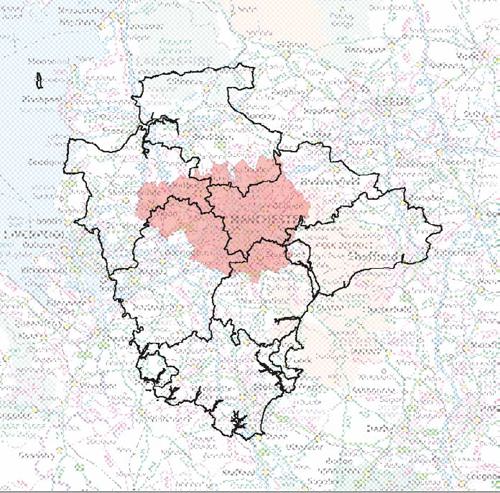
Figure 1. Scale comparison of geographic Devon against the administrative area of Greater Manchester
This proposal avoids the pitfalls of large unitary councils which would dilute identity and service responsiveness, and provides a balance against over fragmentation.
Our four unitary solution preserves distinct urban identities, while giving rural Devon – whether in coastal or countryside communities – a single, focused advocate.
We have a clear public mandate for Torbay Council to continue on its existing boundaries.
Engagement shows strong attachment to local identity and concern about democratic distance in larger, centralised structures.
Responses to Torbay’s engagement survey gave a clear majority in favour of retaining unitary status on current boundaries, with confidence in the Council’s responsiveness, stability and regeneration trajectory.
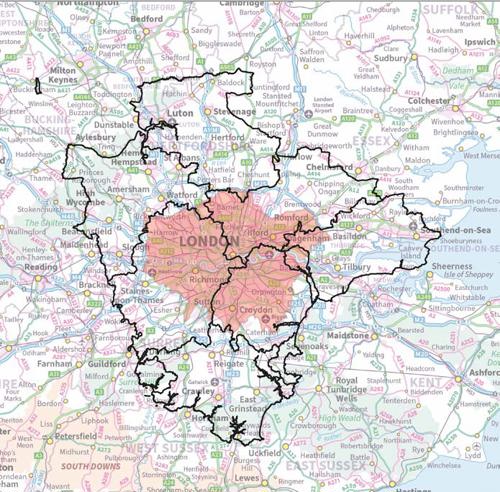
Figure 2. Scale comparison of geographic Devon against the administrative area of Greater London
Preserving Torbay’s unitary status protects momentum at a critical “moment in time” for the English Riviera’s regeneration and maintains accountability close to our communities.
Protecting nationally significant integrated care.
Torbay’s pioneering Integrated Care Organisation – delivering joined up health and adult social care for nearly two decades – is a keystone of resilient services for an ageing population.
Boundary changes that dissolve Torbay’s current status risk unpicking this model, with disruptive consequences for vulnerable residents. Retaining Torbay as a standalone unitary offers a replicable blueprint for place based adult social care elsewhere in Devon and across England and, to this end, we are supporting the Casey Commission in their considerations of the future transformation of adult social care.
Meeting the Government’s criteria
Establishing a single tier of local government
The proposal delivers a single tier of local government across Devon.
It uses existing principal authorities as building blocks for our Base Proposal. Our Modified Proposal refines these boundaries, where there are strong services based and financial rationales and a public mandate to do so. Our Modified Proposal comprises:
- Torbay - continuing as a unitary council with proven success in delivering integrated services, from children’s services to innovative health partnerships and our resilient community and voluntary sector.
- Expanded Plymouth - expanding to serve communities across the city and surrounding areas that already rely on Plymouth for employment, education and healthcare. A council with the scale to compete nationally and drive growth.
- Expanded Exeter - unlocking the potential of one of Britain’s fastest-growing cities, giving it the coherence and capacity to plan strategically for housing, transport and economic growth across its natural economic area.
- Rural Devon Coast and Countryside - a council specifically designed for rural and coastal communities, with services tailored to the challenges of dispersed populations, market towns and isolated areas.
We believe that our proposal is based on sensible economic areas and coherent geographies for housing delivery; creating the right conditions for continued growth with local accountability.
Efficiency and capacity with the ability to withstand financial shocks
The tax base of each unitary council, and the resources available to it per head of population, are balanced, without conferring undue advantage.
Our financial modelling has been developed jointly between our Chief Financial Officers and independent advisors (including Pixel Financial Management and PeopleToo). It shows that around £58 million of organisational and service savings can be made, with transition costs of approximately £52.5 million, yielding payback in two to three years.
The savings are prudently attainable through leadership consolidation, systems rationalisation and service transformation. In particular, service efficiencies can be found through demand management, market shaping and standardised best practice in adults’ and children’s services.
With continuing authority status for Torbay Council and Plymouth City Council, disruption and costs are minimised in these areas. The boundary refinements for Exeter and Plymouth improve sustainability and the balance of resources.
High quality, sustainable public services
Our four authority solution enables targeted responses to distinct local needs. The model avoids fragmentation, maintains continuity where services are strong, and enables tailored improvement where weaknesses persist. It also preserves clear accountability for performance variation, rather than masking differences within larger authorities.
It builds on the existing capacity of the established unitary councils in Torbay and Plymouth. It will maintain and improve the services for our most vulnerable. Our transformation and improvement journeys will continue but the opportunities for further integration and transformation will be maximised.
Local innovation will be at the heart of improving crucial services. Working closely with our communities we can reimagine how we operate – supporting people where they live, with services that are tailored to meet their needs.
Working together to understand and meet local needs
Our proposal is the product of sustained joint working across Devon’s councils, shared data and evidence, and wide engagement with residents, anchor institutions, businesses and voluntary and community sector partners.
Ten of the eleven Devon councils used a shared survey framework and the four unitary solution responds directly to what people said they value:
- decisions made locally
- accessible councillors and services
- protection of distinct identities.
Our proposal retains the distinct urban profiles of Torbay and Plymouth and elevates Exeter to reflect its growing strategic role. The new Rural Devon Coast and Countryside Council ensures that rural priorities are not overshadowed by urban agendas.
Supporting devolution arrangements
Our proposal provides the building blocks for the establishment of a South West Peninsula Mayoral Strategic Authority – with the four unitary solution providing sensible population ratios, ensuring equal partners in size as well as in name.
It establishes equal status and coherent membership for a Mayoral Strategic Authority, enabling greater powers and investment in transport, skills, housing, and growth. This supports defence and marine autonomy in Plymouth, science and data initiatives in Exeter, coastal renewal in Torbay, and rural productivity as well as net zero efforts across the County.
Building on the work already in progress with the Devon and Torbay Combined County Authority, further devolution will enable Devon to:
- maximise the potential of our exceptional environmental assets and internationally significant research capacity
- support the vital national security role of Devonport dockyard
- address our specific housing pressures with a strategic approach to housing, affordability and availability
- create an integrated transport network that connects rural and coastal communities with our urban centres and beyond
- develop coordinated skills provision that meets the needs of our key growth sectors and addresses productivity challenges.
Stronger community engagement and neighbourhood empowerment
Each unitary will deploy locality based service models and neighbourhood governance suited to its context. These will leverage Torbay’s Community Partnerships, the strong parish networks across rural Devon, and urban forum models for Plymouth and Exeter. This is a better democratic settlement than oversized entities that push decision making further away from residents.
Using the pillars of:
- tackling local challenges
- developing locally owned solutions
- evidence - and insight-led practice, we will create local solutions which focus on prevention, encouraging local action which strengthens neighbourhoods. We will better understand the needs in local communities so we can target support and collaborate at the right scale.
Similarly, proposed councillor numbers in each authority reflect the needs of each authority and the communities they represent, not least the parishes and wards which will form an expanded Plymouth City Council and an expanded Exeter Council.
A future built for every community
Devon stands at a transformative crossroads.
We are proposing a bold new model: four unitary councils designed around how people actually live, work, and access services. This isn’t change for its own sake - it’s a strategic shift toward clearer accountability, integrated services, and almost £500 million in reinvestment across the County.
The proposal reflects Devon’s diversity: thriving urban centres, resilient coastal towns, and vast rural communities. It empowers each area – Torbay, expanded Plymouth, expanded Exeter, and Rural Devon Coast and Countryside - with tailored governance, financial sustainability, and the capacity to deliver modern, people-centred services. Families will no longer navigate fragmented systems; businesses will benefit from coherent planning; and young people will have opportunities close to home.
This is about more than structure. It’s about culture: removing barriers, fostering collaboration, and building councils that serve people, not bureaucracy. With strong local voices, strategic capacity, and readiness for further devolution, Devon can lead nationally while staying rooted in community.
This isn’t just Torbay’s moment in time – it’s Devon’s moment to shape a future that works for everyone. Four councils working together for Devon. Focused on place, growing with purpose.
Introduction
Our proposal sets out a new vision for a single tier of local Government in Devon – with unitary councils across Devon that focus on their place and which can grow with purpose to create a better Devon for everyone.
It builds on what works well today and looks forward to what will be needed in the future to best protect, support and enhance communities and our built and natural environments.
Together with the shared aspiration for a new Mayoral Strategic Authority for Devon, this proposal lays the foundations for giving the people of Devon much greater control over the outcomes that matter to them most.
Structure of our proposal
Our proposal is divided into three parts:
Part 1 describes the future of local Government in Devon; why we need to reorganise local government, the challenges and opportunities our County faces and what we believe to be the optimal unitary solution for Devon’s future.
This includes a detailed options appraisal that sets out the strengths, weaknesses and financial feasibility of each viable unitary model against the Government’s criteria for local government reorganisation. It provides an overview of our base and modified proposals in compliance with the requirements of the Local Government and Public Involvement in Health Act 2007. Further it establishes why we are proposing a four unitary solution for Devon.
Part 2 sets out our case for change; providing an in depth assessment of the preferred option against each of the Government’s six criteria within their invitation letter.
Part 3 provides a high level implementation plan; together with our asks of Government to support successful implementation. Accompanying our proposal is a separate appendix which includes the evaluation of our resident and stakeholder engagement, as well as our detailed financial analysis and assumptions.
Development of our proposal
Our proposal has been developed through joint working, meaningful dialogue and insight building. Throughout its development we have prioritised open collaboration and evidence; and ensured our direction is informed by the perspectives of local people and partners.
Open collaboration and evidence
Local government reorganisation is already a force for change. It has brought all of Devon’s authorities into closer communication, creating brilliant opportunities for ongoing cooperation and paving the way for further shared services and joint commissioning. Torbay Council has been an active and solution focused partner in discussions with Plymouth City Council as a fellow existing unitary authority as well as with the County Council and the Districts and Boroughs, including Exeter City Council.
We led on putting in place an information sharing agreement between Devon’s 11 councils and, jointly with Plymouth City Council, on establishing a shared data repository housed at Plymouth City Council. Data collected from across Torbay Council’s directorates has been made openly available to all.
We have researched best practice around Local Government Reorganisation (LGR) by studying proposals developed in other areas in previous rounds of LGR as well as the recent proposals that have been prepared in the Devolution Priority Programme areas.
We developed a methodology for our options appraisal that combines qualitative and quantitative assessment, and rigorously tested our insights through repeated evaluation and scoring exercises with councillors and senior officers.
We sought the right external support and contributed to work commissioned by others. We commissioned PeopleToo to provide a check and challenge on our key assumptions around children’s and adults’ services. Devon’s chief financial officers have worked closely together and alongside Pixel Financial Management to gather and develop financial insights. We benefited from the expertise of Newton Consulting, KPMG and Newtrality by fully participating in workshops, meetings and output development enabled by the County Council, the District and Boroughs and Exeter and Plymouth City Councils.
From the outset we have placed a premium on being a sensible broker and mature partner, sharing resources, seeking agreement and leading with openness and respect.
Led by the views of our communities and partners
Collaboration has also been at the heart of our engagement with our communities and stakeholders. Torbay Council has worked with its district and borough colleagues to coordinate engagement activity, share feedback and best practice, and deliver consistent messaging. Surveys, engagement events and briefings have taken place across Devon and Torbay.
Alongside that, Plymouth City Council undertook its “Big Community Consultation” on its proposals for LGR. This included facilitated consultation events across Plymouth and South Hams as well as two surveys.
Further, Exeter City Council hosted an online survey as well as an enhanced representative survey for the residents in the rural and coastal wards within their proposed area (conducted by external market researchers). The existing unitary councils and the district and borough councils all ran wide-ranging information sharing and awareness raising campaigns, to encourage as broad a response as possible to the engagement.
With ten out of the eleven councils across Devon sharing the broad basis of an engagement questionnaire, we have based our proposal on what our communities have told us matters most about their places and local government.
Key themes from the surveys include:
- Residents expressed a strong emotional and cultural connection to their local areas, emphasising the importance of preserving distinct community identities.
- There was widespread concern that larger, centralised councils would be disconnected from local needs and diminish local representation.
- Respondents overwhelmingly supported governance models that enable decisions to be made locally, with councillors and services accessible within their communities.
- There was a desire to respect and maintain the rural and coastal character of towns and villages, with many expressing fears that being absorbed into larger authorities would lead to a loss of identity and neglect of local priorities.
Specifically, from Torbay Council’s engagement survey 1, there is support for Torbay Council remaining as a continuing unitary authority on its existing boundaries with 64% of respondents in favour of this option.
People have confidence in Torbay Council. Among those who feel Torbay should remain as a continuing unitary authority, the Council is seen as:
- functioning well
- financially stable
- responsive
- delivering regeneration to the area.
People felt that Torbay Council was already delivering well against the Government’s LGR criteria.
Throughout the development of our proposal, we have actively engaged with our partners across Devon. We have sought to understand the strengths and weaknesses of the options under consideration, the challenges and outcomes our partners would wish to see, and how we can better align all of our strategic priorities to deliver together for our communities.
Full details of how we have worked together to understand and meet local needs (Government’s Criteria 4) is set out in our case for change.
1Our engagement survey ran from 1 July to 2 September 2025 and received 1,430 responses. The full engagement report is available in Appendix 1. Back to text.